


7-9 October 2026, Motihari
ICAR–Mahatma Gandhi Integrated Farming Research Institute, Motihari, Bihar, organised a three-day residential training programme on improved crop management in flood-affected Diara and Chaur lands from 7 to 9 October 2026, sponsored by the Bihar Agricultural Management and Extension Training Institute (BAMETI), Patna. The programme focused on strengthening technical knowledge and practical skills in post-flood agricultural recovery, efficient natural resource management, crop diversification and climate-resilient farming practices.
The training was inaugurated in the presence of Dr Raghavendra Singh, Director, ICAR-MGIFRI, and Dr D. P. Dhir, Deputy Project Director, ATMA, with ceremonial lamp lighting and interaction with participants.
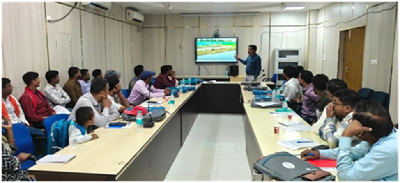
Addressing the gathering, Dr Singh highlighted the challenges of recurrent flooding, prolonged waterlogging and uncertain water recession in Bihar. He emphasised the need for location-specific crop planning, timely sowing, zero-tillage, improved soil health management and integrated farming systems to enhance agricultural productivity and farmers' resilience. He also stressed the importance of translating scientific innovations into practical, economically viable solutions for flood-affected farming communities.
The technical sessions covered flood-risk assessment, weather-based advisories, contingency crop planning, post-flood soil and land management, soil carbon enrichment, balanced nutrient management, conservation agriculture, irrigation scheduling and integrated pest and weed management. Special attention was given to crop diversification and the productive utilisation of residual soil moisture for timely establishment of subsequent crops.
A major highlight was the emphasis on integrated farming systems (IFS) for low-lying and seasonally waterlogged lands. Participants learned about combining field crops, horticulture, fisheries and organic-resource recycling to improve resource-use efficiency and diversify farm income.
Practical demonstrations and field visits at the ICAR-MGIFRI research farm and KVK, Piprakothi, provided insights into the Rice–Fish–Duck integrated farming system, vermicomposting, water-based farming components and improved horticultural nursery management.
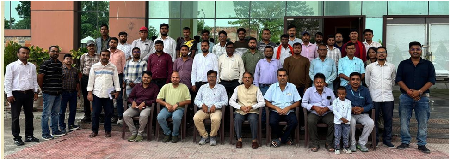
Interactive discussions and field-based learning enabled participants to relate scientific recommendations to local farming challenges. The programme also addressed Chaur fisheries management, horticulture-based diversification, fruit cultivation in flood-prone areas, extension approaches and government schemes supporting post-flood agricultural development.
The training strengthened research–extension linkages and practical understanding of flood-resilient agricultural technologies, highlighting opportunities to transform flood-affected lands into productive and diversified farming systems.
Through this initiative, ICAR-MGIFRI reaffirmed its commitment to sustainable agricultural development, improved resource management and livelihood resilience in Bihar's Diara and Chaur ecosystems.
(Source: ICAR–Mahatma Gandhi Integrated Farming Research Institute, Motihari, Bihar)





फेसबुक पर लाइक करें
यूट्यूब पर सदस्यता लें
X पर फॉलो करना X
इंस्टाग्राम पर लाइक करें