

ICAR–Krishi Vigyan Kendra, Mitraniketan, Thiruvananthapuram, Kerala has played a pivotal role in popularizing mushroom cultivation in the state. Recognizing mushroom cultivation as a low-investment, high-return enterprise ideally suited for small and marginal farmers, the KVK adopted a comprehensive strategy to promote this sector. Through continuous capacity building, input support, and field-level interventions, the KVK strengthened the skills and confidence of farmers. Regular production and distribution of quality mushroom spawn, establishment of demonstration units, and vocational training programmes enabled farmers, farm women, and rural youth to take up mushroom cultivation as a sustainable and profitable livelihood option.
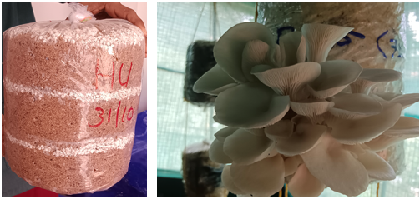
Despite the growing demand and nutritional importance of mushrooms, several challenges limited its widespread adoption. These included lack of technical knowledge in mushroom production and spawn handling, capital constraints and difficulty in accessing credit, unavailability of inputs—particularly quality spawn and infrastructure labour shortages for sustained operations, and marketing issues such as limited local demand, perishability, low prices, and high transportation costs. Low volume of production further made market presence difficult and less profitable.
To overcome these barriers, the KVK implemented a range of strategic interventions. Regular training programmes were organized to strengthen technical skills and build confidence among farmers. Low-cost demonstration units on mushroom cultivation were established to provide practical exposure. An in-house spawn production unit with a capacity of over 1,000 spawns per month was set up to ensure timely availability of quality inputs. On-Farm Trials and Front-Line Demonstrations were conducted to introduce improved techniques under field conditions. Vocational training programmes, with special focus on spawn production, were organized for skill development. Continuous field visits, consultations, free advisory services, method demonstrations, entrepreneurship development programmes, extension literature, and telecast of successful entrepreneurs supported effective knowledge dissemination and adoption.
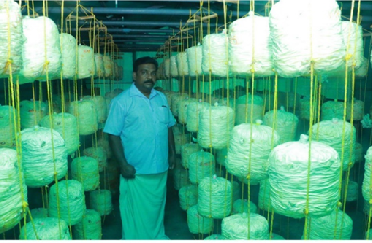
Farmers found the technology practical, affordable, and easily replicable even in limited spaces. The ease of adoption was especially appreciated by women and landless farmers who could implement the technology with minimal resources. Local entrepreneurs valued the steady availability of quality spawn along with regular technical guidance provided by the KVK. Although a few farmers faced difficulties in managing environmental conditions, these challenges were effectively addressed through timely advisory services and on-site support from the KVK.
As a result of these efforts, the technology witnessed significant spread. Over time, 54 small-scale and 24 large-scale mushroom production units were established. Mushroom-based enterprises gained popularity as alternative income sources in rural and peri-urban areas, with improved awareness and skill-building efforts leading to increased participation of youth and women.
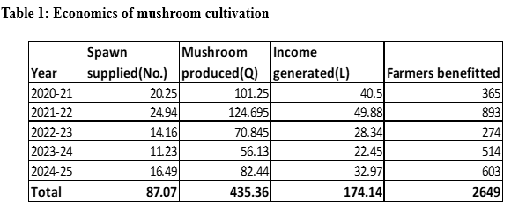
The mushroom cultivation initiative demonstrated notable economic benefits at the community level. Over a span of five years, the technology enabled 2,649 farmers to collectively earn an additional income of ₹174.14 lakhs. Along with income enhancement, the initiative generated sustainable and home-based employment opportunities, particularly benefiting women and rural youth. It contributed to improved household income stability and promoted local entrepreneurship.
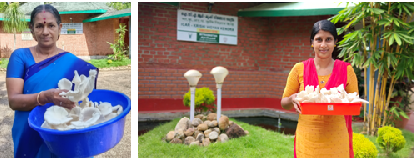
The technology also resulted in several other beneficial effects. Mushroom consumption enhanced nutritional security by providing high-quality proteins and vitamins. Health benefits included low-calorie, high-fiber, and cholesterol-free food, which was particularly beneficial for diabetic and hypertensive patients. Women empowerment was strengthened as many production units were operated by women self-help groups and housewives. Employment generation occurred through spawn production and value-added mushroom products, while vocational training enhanced skills and encouraged youth to take up agripreneurship.
Horizontal spread of the technology was facilitated as trained farmers became resource persons, extending support and mentoring to new growers. KVK-facilitated linkages with institutions and markets further helped expand the practice. Although mushroom cultivation is not land-intensive, its household-based model ensured wider coverage, with more than 78 production units supported across multiple Panchayats, emphasizing inclusiveness in terms of number of households rather than acreage.
Overall, the focused approach of the KVK in promoting mushroom cultivation significantly contributed to rural livelihood development in Thiruvananthapuram district. Through a holistic package of training, technical support, spawn supply, and entrepreneurship development, farmers gained economic benefits, generating additional income of ₹174.14 lakhs over the intervention period. This low-cost, nutrition-rich, and space-efficient agricultural model stands as a successful example for addressing rural unemployment and malnutrition, particularly in regions with marginal or no land holdings.
(Source: ICAR-Krishi Vigyan Kendra, Mitraniketan, Thiruvananthapuram, Kerala)





फेसबुक पर लाइक करें
यूट्यूब पर सदस्यता लें
X पर फॉलो करना X
इंस्टाग्राम पर लाइक करें