

Marigold cultivation is steadily emerging as a profitable and sustainable income-generating enterprise for farmers in Bishnupur district of Manipur. Owing to its multifaceted uses in plant protection, landscape beautification, loose and cut flower production, garland making, and religious offerings, marigold enjoys consistent market demand throughout the year. Its commercial value peaks during major festivals, making it an attractive option for income diversification among small and marginal farmers.
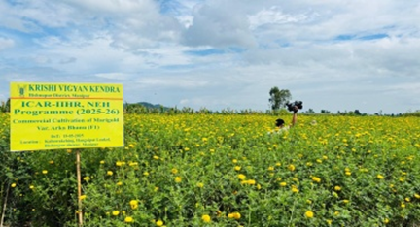
Recognizing this potential, a few progressive farmers in the district began adopting marigold cultivation as an additional source of livelihood. However, the high cost of hybrid seeds often posed a major constraint in scaling up production. Against this backdrop, a motivated rural youth, a graduate by qualification, approached the Subject Matter Specialist (Horticulture) of Krishi Vigyan Kendra (KVK), Bishnupur, to seek technical guidance on scientific marigold cultivation and market opportunities in Manipur.

Intervention and Capacity Building
In response, a three-day training programme on Scientific Production Technology of Marigold for Income Generation, along with the distribution of Arka Bhanu (F1) hybrid marigold seeds, was organized by KVK, Bishnupur from 9–11 April 2025 under the NEH Component of ICAR-Indian Institute of Horticultural Research, Bengaluru. The programme provided comprehensive training on improved agronomic practices, nutrient management, nursery raising techniques, and harvesting methods for enhanced productivity and profitability.
A total of 25 participants, comprising practising farmers and rural youth, actively participated in the programme. Each participant received 7.5 g of Arka Bhanu seeds, sufficient for cultivation over 625 m², with some farmers adopting staggered sowing to ensure continuous flower availability. The intervention generated particular enthusiasm among rural youth, who showed keen interest in expanding cultivation over larger areas as a commercial venture.
Technology Adoption and Crop Management
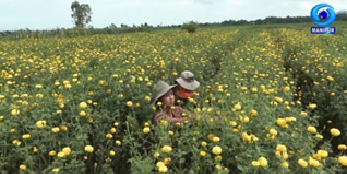
In Manipur, marigold can be cultivated throughout the year. Nurseries were raised during May–June using thermo boxes, raised beds, and pro-tray methods at farmers’ fields. Seedlings were transplanted 15–20 days after sowing onto raised beds of 2 m width, maintaining a spacing of 60 cm × 45 cm.
For an area of 625 m², the recommended inputs included:
Farmyard manure (FYM): 500 kg
Urea: 10 kg
Single Super Phosphate (SSP): 15 kg
Muriate of Potash (MOP): 8 kg
FYM was incorporated during final land preparation, while one-third of urea along with the full dose of SSP and MOP was applied as a basal dose. The remaining urea was top-dressed at 50 and 75 days after transplanting. Immediate irrigation was provided after transplanting, although some farmers opted for minimal chemical fertilizer use and relied only on life-saving irrigation, highlighting the crop’s adaptability.
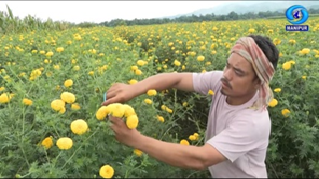
The first flower harvest commenced 55–60 days after transplanting, and plucking continued for 2–2.5 months at intervals of 2–3 days, ensuring regular market supply.
Performance, Market Acceptance, and Impact
The demonstration of Arka Bhanu marigold under the NEH Component received widespread appreciation from participating farmers as well as neighbouring farmers from nearby districts. Its robust performance, attractive flower quality, and excellent market acceptance encouraged farmers to adopt year-round cultivation.
Key advantages observed with Arka Bhanu (F1) included:
Long and sturdy stalks suitable for bouquet making
Dense petal arrangement with longer shelf life compared to local varieties
Suitability for both loose and cut flower markets
High market demand during Lakshmi Puja and Deepawali, fetching ₹130–200 per kg
High profitability from garland making, with 350–360 g garlands sold at ₹200 each
Tall plant stature reducing drudgery during flower plucking
Bright yellow flowers of preferred size for temple offerings, decorations, and household use
Social Recognition and Outreach
The social impact of this intervention was equally significant. Flowers produced from Arka Bhanu were used to decorate the stage and prepare flower vases during the Zonal Workshop of Krishi Vigyan Kendras under ICAR-ATARI, Zone-VII, held at the Central Agricultural University, Imphal. Furthermore, Doordarshan Kendra (DDK) covered three Arka Bhanu cultivation sites in Bishnupur district and broadcast the success under the programme “Labuk Maikei Panglashi”, enhancing visibility and farmer confidence.
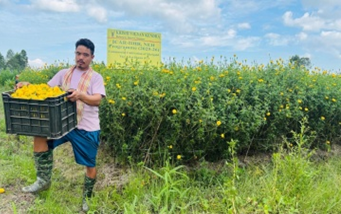
The programme was conducted under the guidance of SMS (Horticulture), KVK Bishnupur, ensuring systematic technical support and monitoring.
Yield and Economic Returns (625 m²)
Average yield: 788.8 kg
Cost of cultivation: ₹11,500
Gross return: ₹70,992
Net return: ₹59,492
Conclusion
The successful demonstration of Marigold F1 hybrid Arka Bhanu in Bishnupur district highlights its immense potential as a high-value floricultural crop. With superior flower quality, high yield, strong market demand, and attractive economic returns, Arka Bhanu has emerged as a preferred choice among farmers and rural youth for year-round cultivation. The intervention has not only enhanced farm income but also contributed to livelihood diversification, employment generation, and sustainable agricultural development in the region. Additionally, marigold cultivation offers flexibility as both a sole crop and intercrop, further strengthening its role in resilient farming systems.
(Source: ICAR-Krishi Vigyan Kendra, Bishnupur)





फेसबुक पर लाइक करें
यूट्यूब पर सदस्यता लें
X पर फॉलो करना X
इंस्टाग्राम पर लाइक करें