

8–10 September 2026, Kolkata
ICAR-Central Research Institute for Jute and Allied Fibres, Barrackpore, in collaboration with CSIR-Central Mechanical Engineering Research Institute (CSIR-CMERI), organised a three-day Farmers’ Training Programme on “Sensor-based Water Management in Jute-based Cropping System” from 8–10 September 2026 under the DST-SEED Project, Government of India. The programme was specifically organised for Scheduled Caste (SC) farmers to create awareness and build practical capacity in the efficient and judicious use of irrigation water.
A total of 80 SC farmers from 11 villages covering Swarupnagar, Berabaria, Tentulia and Satyapole Gram Panchayats of North 24 Parganas, West Bengal, participated in the programme, with around 25–30 farmers attending each day. The training focused on judicious use of groundwater, conservation of natural water resources, improved water-use efficiency and enhancement of crop productivity through need-based irrigation management.
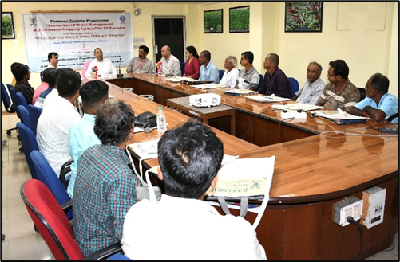
The programme was inaugurated on 8 September by Dr Gouranga Kar, Director, ICAR-CRIJAF. Addressing the farmers, Dr Kar emphasised the need to move away from indiscriminate and conventional irrigation practices towards scientific, need-based and water-efficient irrigation management. He highlighted that groundwater is a valuable and finite natural resource and stressed the importance of its judicious use. He further underlined that improved water-use efficiency can contribute simultaneously to groundwater conservation, reduction in unnecessary irrigation, better crop performance and sustainable agricultural production.
Dr Kar encouraged farmers to adopt technologies that enable irrigation to be applied only when and where it is required, rather than following fixed irrigation schedules. Such an approach, he noted, is particularly relevant to jute-based cropping systems, where efficient water management can help conserve groundwater while maintaining or improving crop productivity.
The training programme combined classroom sessions with practical demonstrations. The major topics covered included sensor-based irrigation management in jute-based cropping systems, scientific and need-based irrigation scheduling, deficit irrigation management in jute, micro-irrigation for improved water-use efficiency, and the role of Water Users’ Associations in West Bengal in strengthening community-level management of water resources.
A key highlight of the programme was the hands-on demonstration of IoT-based irrigation management prototypes developed by CSIR-CMERI in collaboration with ICAR-CRIJAF. The sensor-based systems were deployed at ICAR-CRIJAF and successfully operated under field conditions. Farmers were provided practical exposure to the functioning of the sensors and their application in monitoring field conditions and facilitating efficient irrigation management.
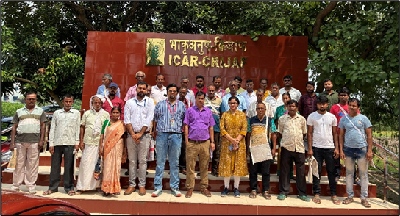
The participating farmers showed keen interest in the technical sessions and demonstrations and actively interacted with the experts on the application of the technology under field conditions. The sensor-based system generated considerable interest for its potential to provide an alternative to conventional irrigation practices and promote more efficient use of water. The bilingual and user-friendly operational features of the system were also appreciated for their potential to facilitate wider adoption of the technology among farmers.
The training programme enhanced farmers’ awareness of groundwater conservation and efficient water management while providing them with practical knowledge of sensor-based irrigation technologies. The programme reinforced the message that “every drop of water should be used judiciously” and that improved water-use efficiency is essential for sustainable and profitable crop production.
The successful completion of the training, marked by the participation of 80 SC farmers and field-level demonstration of the sensor-based IoT prototypes, represents an important step towards promoting water-saving, technology-driven and climate-resilient jute-based farming systems.
(Source: ICAR-Central Research Institute for Jute and Allied Fibres, Barrackpore)





फेसबुक पर लाइक करें
यूट्यूब पर सदस्यता लें
X पर फॉलो करना X
इंस्टाग्राम पर लाइक करें