

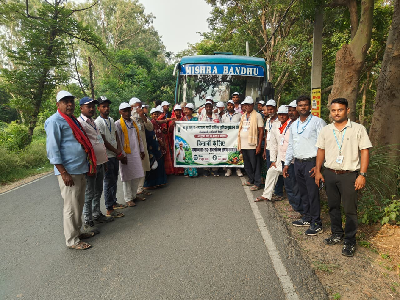
As part of the nationwide Khet Bachao Abhiyan–2026, ICAR–Mahatma Gandhi Integrated Farming Research Institute, Motihari, organized a farmers' exposure visit to Khet Bachao Abhiyan programme held at Naubatpur, Patna, providing farmers from East Champaran district with an opportunity to observe and learn about Integrated Farming Systems (IFS) and other climate-resilient agricultural technologies for sustainable farming.
The exposure visit was organized under the overall guidance of Dr Raghavendra Singh, Director, ICAR-MGIFRI, as part of the institute's continuous efforts to strengthen farmer awareness, technology dissemination, and the adoption of integrated, soil-health-centered farming systems across Bihar.
The exposure visit served as a practical learning platform where farmers gained first-hand knowledge of Integrated Farming Systems (IFS), soil health restoration, balanced fertilizer use, green manuring, crop diversification, direct-seeded rice (DSR), crop planning, and climate-resilient agricultural practices.
During the programme, agricultural experts emphasized the large-scale adoption of IFS-models, biofertilizers, biopesticides, organic manures, green manuring, and crop residue recycling as sustainable pathways for improving productivity while restoring soil health. Farmers were informed that healthy soils are the foundation of productive agriculture, nutritional security, environmental sustainability, and long-term farm profitability. Scientists encouraged participants to become ambassadors of the Khet Bachao Abhiyan by disseminating scientific knowledge within their respective villages.
The programme highlighted the importance of integrating crop, fisheries, livestock, and horticultural enterprises to improve farm resilience, resource-use efficiency, and profitability. Farmers were introduced to the concept of the soil–crop–livestock–fish–human health continuum, demonstrating how fish-based Integrated Farming Systems facilitate efficient nutrient recycling, diversify farm income, strengthen household nutritional security, and enhance climate resilience through the optimum utilization of on-farm resources.
Technical sessions also emphasized the role of Dhaincha (Sesbania) green manuring, direct-seeded rice (DSR), crop residue recycling, and the inclusion of summer green gram in rice-based cropping systems as effective strategies for restoring soil health. Farmers were informed that these practices enhance soil organic carbon, stimulate beneficial microbial activity, improve nutrient-use efficiency, reduce dependence on chemical fertilizers, and support long-term soil fertility. The sessions further highlighted that incorporating Dhaincha before rice cultivation can substantially reduce nitrogen fertilizer requirements in the succeeding crop while improving overall soil health and sustaining productivity.
Scientists further highlighted the importance of soil-test-based nutrient management, conservation of fertile topsoil, prevention of crop residue burning, and promotion of soil-building practices. Farmers were advised that recycling crop residues, incorporating green manures, and adopting diversified cropping systems significantly improve soil fertility, water-holding capacity, biological activity, and resilience to climatic stresses.
Special attention was given to crop planning and crop calendar-based varietal selection in rice-based production systems. Farmers were advised to select rice varieties according to the anticipated transplanting period so that succeeding rabi crops such as wheat and maize can be sown on time, thereby improving cropping intensity, resource-use efficiency, productivity, and profitability.
The exposure visit also provided an opportunity for farmers to interact directly with scientists from ICAR institutes, State Agricultural Universities, Krishi Vigyan Kendras (KVKs), and officials of the Department of Agriculture, Government of Bihar. Participants exchanged experiences on sustainable agriculture, integrated farming, and innovative technologies suitable for the flood-prone and waterlogged agroecosystems of Bihar.
Farmers highly appreciated the exposure programme and expressed their willingness to adopt IFS-models, balanced fertilizer use, green manuring, crop diversification, soil testing, and other soil-health-centered technologies on their own farms. They also committed to sharing the knowledge gained during the visit with fellow farmers to strengthen the grassroots implementation of the Khet Bachao Abhiyan–2026.
The programme concluded with a collective resolve to accelerate the adoption of Integrated Farming Systems and climate-resilient agricultural technologies through stronger collaboration among farmers, scientists, ICAR institutes, State Agricultural Universities, Krishi Vigyan Kendras, and the Department of Agriculture, Government of Bihar, thereby promoting sustainable agricultural development and resilient livelihoods across Bihar.
Nearly 60 progressive farmers from East Champaran district, accompanied by scientists from ICAR-MGIFRI, participated in the programme.
(Source: ICAR–Mahatma Gandhi Integrated Farming Research Institute, Motihari, Bihar)





फेसबुक पर लाइक करें
यूट्यूब पर सदस्यता लें
X पर फॉलो करना X
इंस्टाग्राम पर लाइक करें