

24 June 2026, Motihari, Bihar
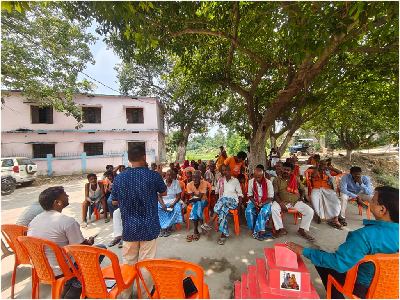
As part of the nationwide Khet Bachao Abhiyan–2026, ICAR–Mahatma Gandhi Integrated Farming Research Institute, Motihari, in collaboration with the Agricultural Technology Management Agency (ATMA), organized a farmer awareness programme at Siswah village, Banjaria Block, East Champaran district, Bihar. The programme focused on soil health restoration, balanced fertilizer use, rice nursery management, green manuring, and eco-friendly pest and disease management for climate-resilient agriculture.
Addressing the gathering, the speakers emphasized the importance of soil-test-based fertilizer application for improving nutrient-use efficiency, reducing unnecessary expenditure on fertilizers, and maintaining long-term soil fertility. Farmers were advised to adopt balanced fertilization involving nitrogen, phosphorus, potassium, sulphur, and micronutrients according to soil test recommendations rather than relying on blanket fertilizer applications.
The role of biofertilizers, including nitrogen-fixing, phosphorus-solubilizing, and potassium-mobilizing microorganisms, in improving nutrient availability and strengthening soil biological activity was also highlighted. Farmers were encouraged to integrate biofertilizers with organic manures and balanced fertilizer use for sustainable nutrient management.
Special emphasis was given to rice nursery management, where farmers were advised on healthy seed selection, seed treatment, optimum seed rate, proper drainage, and nursery hygiene. It was explained that well-managed nurseries produce vigorous seedlings, reduce disease incidence, and contribute to better crop establishment and higher yields.
Eco-friendly approaches for pest and disease management were also discussed, with emphasis on the use of neem-based formulations, biological control agents, clean cultivation practices, and regular field monitoring. Farmers were encouraged to adopt integrated pest management (IPM) approaches to reduce dependence on chemical pesticides while maintaining crop health and productivity.
The scientists also highlighted the importance of green manuring through Dhaincha (Sesbania) and the inclusion of green gram and other pulse crops in rice-based cropping systems. Farmers were informed that pulse crops contribute to soil fertility through biological nitrogen fixation, improve farm profitability, and enhance household nutritional security.
During the interactive session, several farmers shared their experiences of cultivating summer green gram and acknowledged its role in reducing nitrogen fertilizer requirements for succeeding rice crops. Participants also expressed considerable interest in adopting Dhaincha as a green manure crop, although timely availability of quality seed was identified as a key challenge for large-scale adoption.
Farmers were sensitized about the harmful effects of crop residue burning and the benefits of residue recycling for improving soil organic carbon, nutrient availability, moisture conservation, and microbial activity. Scientists emphasized that maintaining and enhancing soil organic carbon is critical for sustaining soil fertility, improving water-holding capacity, and building resilience against climate variability.
Participants were encouraged to adopt composting, farmyard manure application, crop residue recycling, pulse-based crop rotations, and green manuring practices for restoring soil health. The programme also highlighted the importance of crop diversification and integrated farming approaches for improving resource-use efficiency and reducing production risks.
The programme received an encouraging response from the farming community, with participants expressing their willingness to adopt soil testing, balanced fertilization, green manuring, pulse inclusion, residue recycling, and eco-friendly crop management practices.
The event concluded with a strong message that protecting agricultural productivity begins with protecting soil health, and that healthy soil, balanced nutrient management, biological inputs, and climate-resilient farming practices are essential for sustainable agricultural development.
The programme strengthened the linkage between research, extension, and farming communities through the joint efforts of ICAR-MGIFRI and ATMA, carrying forward the objectives of the Khet Bachao Abhiyan–2026 across rural Bihar.
A total of 49 farmers, including 37 male and 12 female participants, actively participated in the programme.
(Source: ICAR–Mahatma Gandhi Integrated Farming Research Institute, Motihari, Bihar)





फेसबुक पर लाइक करें
यूट्यूब पर सदस्यता लें
X पर फॉलो करना X
इंस्टाग्राम पर लाइक करें