

18 May 2026, Kolkata and Kanpur
In a coordinated initiative to advance pulse production under the Dalhan Atmanirbharata Mission, ICAR-Agricultural Technology Application Research Institute, Kolkata, in collaboration with ICAR-Indian Institute of Pulses Research, Kanpur, organised a Convergence Meeting-cum-Capacity Building Programme in hybrid mode for Krishi Vigyan Kendras (KVKs) of Odisha and West Bengal. The programme aimed to enhance technical preparedness, institutional convergence, and field-level implementation strategies for pulse promotion in the two states.
Dr Pradip Dey, Director, ICAR-ATARI, Kolkata, underscored the strategic importance of pulses in ensuring nutritional and protein security, enhancing soil health, and advancing sustainable, climate-resilient agriculture, describing them as vital to agricultural self-reliance and ecological sustainability. He called upon KVKs to adopt a proactive, mission-driven approach for promoting pulse cultivation and crop diversification at the grassroots level. Emphasizing the close linkage between pulse diversification, balanced fertilizer use, and the forthcoming Khet Bachao Abhiyan, Dr. Dey noted that integrating pulses into cropping systems strengthens nutrient cycling, lowers dependence on chemical fertilizers, and supports balanced, resource-efficient, and environmentally sustainable nutrient management.
Dr G.P. Dixit, Director, ICAR-IIPR, Kanpur, highlighted the promotion of improved pulse varieties through CFLDs across 421 districts under the Mission framework. He emphasized the targets of expanding pulse cultivation by 5 lakh hectares and enhancing production by 6 lakh tonnes, noting sub-national average yields in several districts of West Bengal and Odisha. Advocating a systems-based approach, he stressed cluster-led dissemination of high-yielding, pest-resistant, and climate-resilient varieties of pigeonpea, lentil, and blackgram.
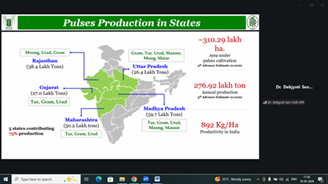
The technical sessions focused on state-specific strategies for kharif pulse cultivation. Discussions highlighted the objectives and agenda of the National Pulse Mission along with region-specific pulse production technologies. The pulse production scenario, newly released pulse varieties suitable for West Bengal and Odisha, and seed availability through Seed Hubs were also presented. Emphasis was laid on achieving pulse self-sufficiency through the timely supply of quality seeds, use of bio-fertilizers, soil health card-based nutrient management, and enhancement of soil carbon. The overall programme was coordinated effectively throughout the sessions.
An interactive Q&A session enabled KVK Heads and Subject Matter Specialists (SMSs) associated with pulse demonstrations to address technical, operational, and implementation-related concerns, fostering knowledge sharing and practical problem-solving.
The programme witnessed enthusiastic participation from KVK functionaries involved in pulse production and demonstrations across both states, strengthening institutional capacity, collaborative convergence, and readiness to achieve the goals of the Dalhan Atmanirbharata Mission.
(Source: ICAR- Agricultural Technology Application Research Institute, Kolkata)





फेसबुक पर लाइक करें
यूट्यूब पर सदस्यता लें
X पर फॉलो करना X
इंस्टाग्राम पर लाइक करें