

19 May 2026, Bhopal
The delegation of the Krishi Vikas Samiti of Madhya Pradesh Vidhan Sabha visited ICAR-Central Institute of Agricultural Engineering, Bhopal today and held an important meeting and discussion on the critical issue of crop residue management and stubble burning. The meeting focused on the present status, challenges, environmental impacts, and sustainable solutions for crop residue management, particularly in Madhya Pradesh and other major agricultural states including Punjab, Haryana, and Uttar Pradesh.
Shri Thakurdas Nagvanshi, Chairman of the Committee, emphasized the role of the Committee in reviewing and promoting technologies related to crop residue management in Madhya Pradesh. He discussed the major challenges arising from improper management of agricultural residues and stressed the need for coordinated efforts among institutions, policymakers, industries, and farmers to ensure sustainable agricultural practices. The meeting was also addressed by committee members Shri Shiv Narayan Singh, Shri Shrikant Chaturvedi, Shri Jitendra Pandya and Shri Sahab Singh Gurjar and attended by number of officers of Department of Agriculture and Agricultural Engineering of Madhya Pradesh.
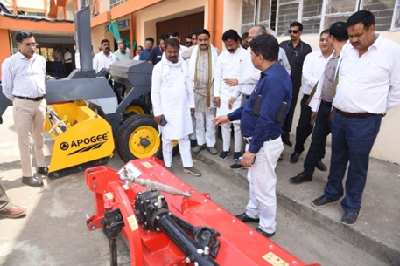
Shri Umesh Sharma, Additional Secretary, Vidhan Sabha Secretariat, addressed the gathering and elaborated on the aims and objectives of the visit of Vidhan Sabha Krishi Vikas Samiti to ICAR-CIAE. He highlighted the increasing concern of crop residue generation and burning, its adverse environmental and health impacts, and the urgent need for effective management strategies.
Dr C.R. Mehta, Director, ICAR-CIAE, presented the major achievements and ongoing developments at the institute. He highlighted institute-developed technologies and their impacts in the field of crop residue management, including advanced machinery and sustainable utilization appro aches. He also briefed the committee about ongoing research related to application of sensors, IoT, robotics in agriculture, renewable energy based technologies, and innovative millet- and soy-based food products. Dr Mehta also elaborated on the status of crop residue generation and stubble burning in different states and emphasized the role of agricultural machinery in managing crop residue effectively. Technologies such as Zero Till Seed Drill, Happy Seeder, Smart Seeder, and Super SMS were highlighted as important solutions for in-situ residue management. He also discussed various ex-situ management options including biomass-based power generation, pellet production, ethanol production, biogas and Bio-CNG generation, briquetting, and composting.
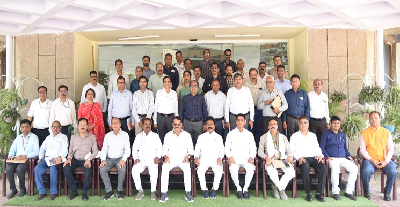
During the discussion, several important points were highlighted, including the need to create awareness about crop residue management among farmers, promotion of suitable machinery, extensive training and demonstrations, and development of practical models to showcase the importance of crop residue management to curb burning in field. The participants also emphasized the need for grassroots-level awareness programs and appreciated the efforts being made by industries such as Reliance and IOCL in addressing crop residue-related issues. The delegation of the Krishi Vikas Samiti, Madhya Pradesh Vidhan Sabha also visited several laboratories of the institute, where live demonstrations of various technologies developed by the institute were presented.
(Source: ICAR-Central Institute of Agricultural Engineering, Bhopal)





फेसबुक पर लाइक करें
यूट्यूब पर सदस्यता लें
X पर फॉलो करना X
इंस्टाग्राम पर लाइक करें