

8 April 2026, Andaman & Nicobar Islands
The Fisheries Science Division of the ICAR–Central Island Agricultural Research Institute, Sri Vijayapuram, Andaman & Nicobar Islands has successfully standardized a biofloc-based culture system for Penaeus vannamei, marking a significant advancement in sustainable aquaculture for island ecosystems.
The system was validated through trials conducted in three indoor circular biofloc tanks, each measuring 4 meters in diameter with a water holding capacity of 10,000 litres. The results demonstrate that shrimp production under this controlled system is economically viable and holds considerable potential for enhancing livelihoods while strengthening local seafood production in the Andaman & Nicobar Islands.
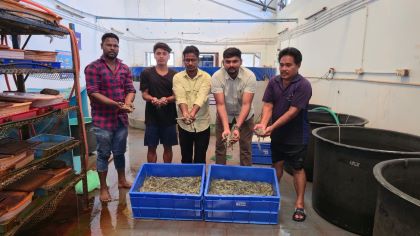
Standardized biofloc management practices, along with optimized harvesting strategies, have yielded an average production of approximately 30–33 kg of shrimp per 10,000-litre tank per harvest cycle. This reflects the system’s efficiency and suitability for intensive aquaculture operations.
The developed model is both scalable and resource-efficient, making it particularly relevant for regions facing constraints in land and water availability. By reducing dependency on large water bodies and improving input utilization, the biofloc system offers a sustainable alternative to conventional shrimp farming practices.
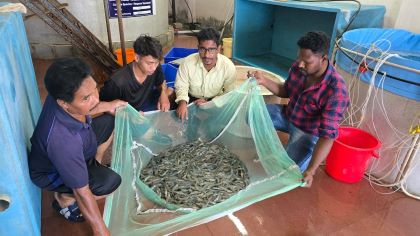
The technology will be showcased at the upcoming Andaman Food Festival, scheduled from 17 to 19 April 2026, where farmers, entrepreneurs, and stakeholders will have the opportunity to witness practical demonstrations and explore its adoption for commercial use.
(Source: ICAR–Central Island Agricultural Research Institute, Sri Vijayapuram, Andaman & Nicobar Islands)




फेसबुक पर लाइक करें
यूट्यूब पर सदस्यता लें
X पर फॉलो करना X
इंस्टाग्राम पर लाइक करें