


Pigeonpea (Cajanus cajan) is a major pulse crop cultivated extensively across the tropics and subtropics and plays a pivotal role in ensuring food and nutritional security for dryland farmers. Predominantly grown under rainfed conditions, pigeonpea is highly sensitive to erratic rainfall, poor seedling establishment, and moisture stress during germination. The crop occupies a significant place in the farming systems of small and marginal farmers, particularly in developing countries. In India, pigeonpea—popularly known as Tur or Arhar—is cultivated over an area of 5.05 million hectares with a production of 4.34 million tonnes and an average productivity of 859 kg/ha, accounting for 77.61 percent of global pigeonpea production. Among major producing states, Uttar Pradesh leads with 0.47 million tonnes from 0.49 million hectares, followed by Madhya Pradesh, West Bengal, Bihar, and Jharkhand. In Karnataka, pigeonpea is one of the principal pulse crops of Northern Karnataka, cultivated over 5.14 lakh hectares with an average productivity of 766 kg/ha. Bidar district, known as the pulse bowl of Karnataka, is a major contributor, where pulses are grown over 2,06,717 hectares, of which 65,642 hectares are under pigeonpea cultivation.
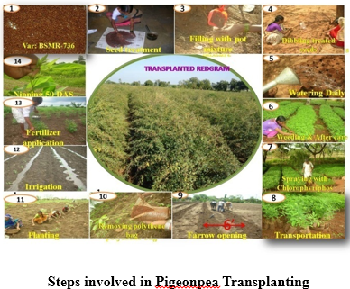
Despite its importance, pigeonpea cultivation in dryland areas is constrained by poor plant stand and low productivity due to traditional practices, improper sowing time, inadequate plant population, pest and disease incidence—especially pod borer—defective sowing methods, insufficient intercultural operations, and limited or improper use of phosphatic fertilizers. Water scarcity and erratic rainfall further aggravate these problems, resulting in an average farmer yield of only 829 kg/ha against a potential yield of 2700 kg/ha, creating a wide yield gap of 1871 kg/ha and reduced profitability. To address these challenges, transplanting technology emerged as a resource-efficient and climate-resilient alternative for improving pigeonpea productivity.
In an effort to bridge this yield gap, ICAR–Krishi Vigyan Kendra (KVK), Bidar facilitated a dynamic Farmers–Scientists Interface, creating a platform for collective brainstorming between progressive farmers and scientists. This interaction led to the conceptualization of innovative ideas centered on transplanting and dibbling technologies. Based on these discussions, ICAR–KVK, Bidar initiated a preliminary trial on transplanting technology during 2004–05 involving 50 plants, which yielded promising results. Encouraged by this outcome, On-Farm Trials were conducted during 2005–06, 2006–07, and 2007–08 across 22 farmers’ fields, comparing transplanting with conventional dibbling and normal sowing methods. The transplanting method consistently outperformed the traditional practices, recording a yield of 48.75 q/ha and establishing itself as a potential breakthrough in pigeonpea production.
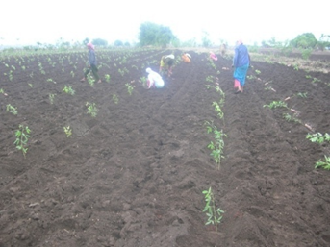
To assess large-scale applicability, Front-Line Demonstrations on pigeonpea transplanting technology were conducted by ICAR–KVK, Bidar during 2008–09 over an area of 15 hectares. During this period, transplanting technology achieved an average seed yield of 29.70 q/ha with a gross income of ₹1,24,740/ha and a net income of ₹1,07,240/ha at a cost of cultivation of ₹17,500/ha. In contrast, the traditional method recorded a yield of 17.5 q/ha with a net income of ₹58,500/ha. Encouraged by these results, ICAR–KVK, Bidar continued the demonstrations from 2009–10 to 2014–15, during which transplanting consistently recorded higher yields, gross income, and net income compared to farmers’ practices, with yield increases ranging from 69.71 to 138 percent.
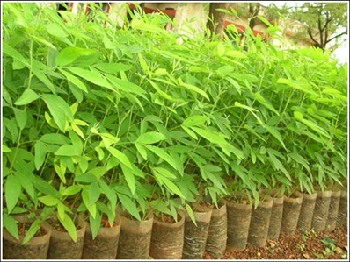
The transplanting technology involves raising pigeonpea seedlings in nurseries or polybags and transplanting them into the main field after 25–30 days. This ensures uniform plant population, better early establishment, and efficient use of the monsoon period. The standardized practice includes seedling raising with a seed rate of 2.5–3.0 kg/ha, nursery management using FYM, red soil, and sand, field preparation with proper spacing, timely transplanting under favourable moisture conditions, balanced nutrient management, and integrated weed and pest management practices.
The technology offers several advantages, including early and uniform establishment, enhanced drought resilience through deep root development, reduced seed requirement, ease of crop management, and significantly higher productivity. On-Farm Trial results showed yields of 48–58 q/ha under irrigated conditions and 34–38 q/ha under rainfed conditions, compared to 6–16 q/ha under conventional practices. Front-Line Demonstrations from 2020–21 to 2024–25 consistently doubled yields and increased net returns to ₹1.07–1.20 lakh/ha, with farmers acknowledging unprecedented gains in productivity and profitability.
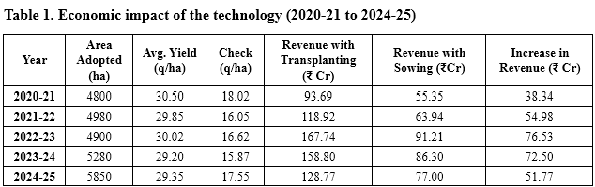
The large-scale adoption of transplanting technology from 2020–21 to 2024–25 demonstrated consistent yield advantages of 70–90 percent, with the area under adoption increasing from 4,800 to 5,850 hectares. Revenue generated through transplanting peaked at ₹167.74 crore, with additional revenue over conventional sowing ranging from ₹38.34 to ₹76.53 crore. These results clearly established transplanting as a high-yielding, economically viable, and scalable technology.
To promote widespread adoption, ICAR–KVK, Bidar implemented a comprehensive dissemination strategy involving training programmes, field days, exhibitions, radio and television programmes, print media, mobile messaging, and the distribution of quality seed through the revolving fund scheme. As a result, the area under pigeonpea transplanting expanded significantly across Bidar district.
Beyond yield and income enhancement, the technology enabled early sowing, escape from terminal drought and pod borer infestation, conservation of water resources, reduced post-harvest losses, and a shift from water-intensive crops like sugarcane to pigeonpea cultivation. This transition improved profitability, reduced production duration, and created additional employment opportunities in nurseries, processing units, and value chain activities, thereby strengthening the livelihoods of small and marginal farmers.
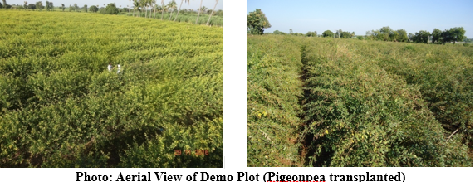
The horizontal spread of pigeonpea transplanting technology extended beyond Bidar to several districts of Karnataka and neighbouring states, leading to improved productivity, optimized resource use, and enhanced sustainability across diverse agro-climatic regions. Farmers in Bidar organized associations for marketing and exporting processed dal, and the district emerged as a hub for pigeonpea processing, generating substantial rural employment.
The key lessons learned from this intervention include the importance of wider spacing, management of excess biomass, provision of protective irrigation, and strong market linkages for long-term sustainability. Overall, pigeonpea transplanting technology has proven to be a low-cost, climate-smart, and farmer-friendly innovation with immense potential for large-scale adoption in semi-arid regions. With continued institutional and policy support, it can play a major role in enhancing farmers’ incomes and achieving national self-sufficiency in pulses.
(Source: ICAR-Krishi Vigyan Kendra, Bidar, Karnataka)





Like on Facebook
Subscribe on Youtube
Follow on X X
Like on instagram