

Introduction
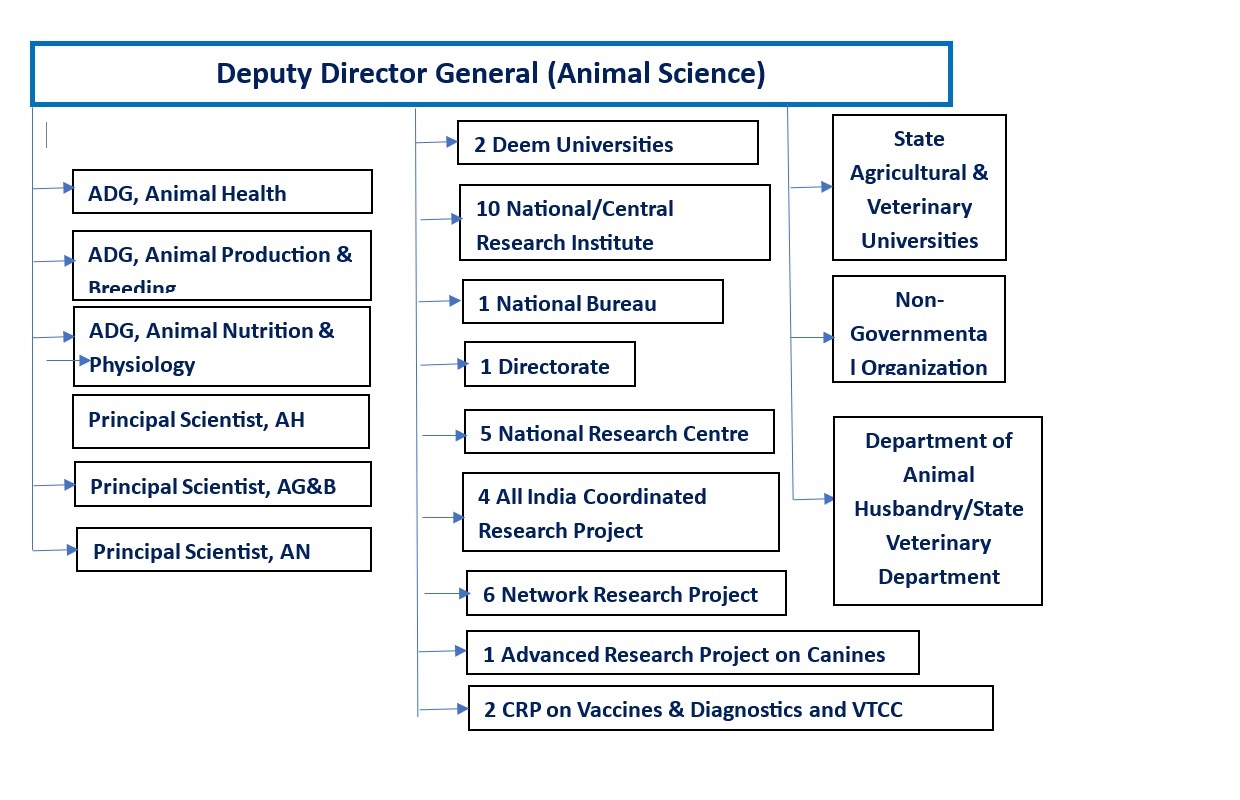
Animal Science Division of ICAR coordinates and monitors research activities in its 19 Research Institutes and their Regional Centers/Stations. The Division has 2 Deemed Universities, 10 National/Central Research Institutes, 1 Bureau, 1 Directorate and 5 National Research Centers. The Division coordinates 4 All India Coordinated Research Projects, 6 network research programmes, 1 Advanced Research Project on Canines, 2 CRPs on vaccines and diagnostics and VTCC.
The Division promotes scientific advancements in animal genetics and breeding, nutrition, reproduction, physiology, health, welfare and production management. It advances genetic improvement, development of superior breeds and conservation of indigenous animal genetic resources. It promotes the integration of genomics, biotechnology, advanced reproductive technologies, bioinformatics, data analytics and artificial intelligence to accelerate scientific innovation and enhance livestock productivity. Through interdisciplinary collaboration, capacity building, technology development and dissemination, Animal Science Division addresses emerging challenges in livestock production. It strengthens evidence-based policymaking and scientific and financial monitoring to enhance productivity, climate resilience, farmers’ income, sustainable animal husbandry, rural livelihoods and national food and nutritional security.
Organogram
Vision
Development of technologies to support production enhancement, profitability, competitiveness and sustainability of livestock and poultry sector for providing food and nutritional security to Indian masses.
Mission
Facilitating need based research in ongoing and emerging areas of livestock and poultry sector to denote productivity increase, reduce gap between potential and actual yield, and to prepare the country for the challenges of globalization.
Mandate
The Animal Science Division, ICAR, plans, coordinates, guides and monitors national research programmes in livestock and poultry. It promotes genetic improvement, breed development and conservation of indigenous animal genetic resources; advances research in nutrition, reproduction, health, genomics and emerging technologies; strengthens interdisciplinary research, technology development and dissemination; monitors research performance; and provides technical inputs for policy formulation to enhance productivity, farmers’ income, sustainable animal husbandry, and national food and nutritional security.
Priority Area
Priority Area During 16th Financial Cycle:
- Accelerate genomic selection, genetic evaluation, and development of superior, climate-resilient livestock breeds, along with sustainable production systems suited to diverse agro-climatic conditions.
- Strengthen indigenous breed characterization, registration, conservation, and the achievement of zero non-descript livestock populations.
- Advance indigenous vaccines, rapid diagnostics, disease resistance, and emerging disease management.
- Promote cost-effective feeding, alternative feed resources, precision nutrition, and improved feed efficiency.
- Enhance the effectiveness of AICRPs, NWPs, and CRPs through focused priorities and measurable outcomes, and initiate two new AINPs on harnessing nutraceutical/therapeutic attributes of milk and the National Animal Disease Epidemiology Network.
- Promote sex-sorted semen, embryo transfer, genomics, biotechnology, bioinformatics, artificial intelligence, and machine learning to accelerate genetic progress and enhance livestock productivity.
- Accelerate field validation, scaling-up, and adoption of proven technologies to maximize livestock productivity, farmers' income, resource-use efficiency, climate resilience, and nutritional security.
- Drive holistic value chain development, capacity building, and institutional strengthening to support sustainable livestock entrepreneurship and rural livelihoods.
Breakthroughs
Breakthroughs since 2021 onwards
- Registered 42 indigenous breeds, characterized 60 populations, and cryopreserved germplasm of 97 breeds, including 23 threatened breeds.
- Registered synthetic breeds and developed three improved chicken varieties; distributed 78.82 lakh units of poultry germplasm.
- Produced India’s first cloned cattle (Ganga), cloned buffalo (Karnika), and pioneering horse and Marwari filly through advanced reproductive technologies.
- Developed cattle and buffalo genomic chips, IndiChick SNP chip, buffalo fertility chip, and CRISPR-edited buffalo embryos.
- Developed 40 region-specific feeding modules and 70 value-added animal-origin products and processes.
- Developed 21 livestock and poultry vaccines and 22 vaccine candidates and 25 diagnostic kits including a commercialized lumpy skin disease vaccine.
- ;Screened over 12 lakh animals and poultry and issued monthly disease alerts to more than 25 lakhs farmers for 15 economically important diseases.
- Produced 24.25 lakh semen doses elite cattle and buffalo.
- Published 5,758 research papers and secu 80 patents.
- Conducted over 2,500 capacity-building programmes, supported more than 2 lakh beneficiaries, and developed 12 milk/meat quality-detection kits benefiting an estimated 2 crore consumers.