


17 Feb - 26 March 2026, Avikanagar
ICAR–Central Sheep and Wool Research Institute, Avikanagar, successfully conducted a landmark capacity-building programme on “Artificial Insemination in Sheep and Goat,” sponsored by the Rajasthan Livestock Development Board (RLDB) under the aegis of the ICAR, New Delhi. The programme, held from 17 February to 26 March 2026 in 14 batches, marked one of the first large-scale training initiatives of its kind in the country.
The valedictory function was graced by Dr Suresh Chand Meena, Director, Animal Husbandry Department, Rajasthan and CEO, RLDB, as the Chief Guest; Dr P. S. Kalra, Manager, RLDB, as the Guest of Honour; and was presided over by Dr Arun Kumar Tomar, Director, ICAR-CSWRI.
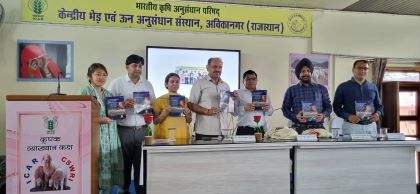
In his address, Dr Meena underscored the importance of sheep and goat farming as a key component of the rural economy and emphasized that the adoption of advanced reproductive technologies can significantly enhance productivity and genetic quality. He assured continued collaboration between the department and ICAR-CSWRI for mission-mode implementation of these technologies across the state. He further informed that artificial insemination equipment for small ruminants has been procured and will be distributed on priority to trained personnel, with plans to expand such training programmes in the future.
Dr Kalra commended ICAR-CSWRI for organizing such practical and technology-driven training and encouraged participants to disseminate the acquired knowledge among farmers.
Despite the challenge of training a large number of participants within a short period, the programme was executed successfully by the Division of Animal Physiology and Biochemistry under the leadership of Dr Arun Kumar Tomar, who also served as the Convener. The institute undertook the initiative with a mission-oriented approach, and the programme is expected to have a significant and lasting impact on the sheep and goat sector in Rajasthan.
Dr Tomar highlighted the immense potential of artificial insemination in sheep and goats for rapid genetic improvement and productivity enhancement, emphasizing the critical role of trained field personnel in its effective implementation.
The training programme covered key advanced reproductive technologies, including estrus synchronization, artificial insemination, use of intravaginal progesterone sponges, semen collection and processing, disease diagnosis, and scientific flock management. These interventions are expected to improve productivity by reducing lambing and kidding intervals and enhancing genetic potential, thereby contributing to increased farmer income.
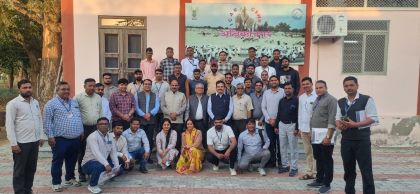
Participants also recommended the inclusion of technologies such as the Avikesil-S progesterone sponge and the “Avi MAIL” (Mobile Artificial Insemination Laboratory), developed by ICAR-CSWRI, for wider adoption in departmental programmes. Notably, several trainees initiated the application of these technologies in their respective regions immediately after the training, successfully carrying out estrus synchronization and artificial insemination in sheep and goats.
The programme concluded with a formal vote of thanks, reaffirming the commitment to strengthening small ruminant development in Rajasthan through scientific interventions.
A total of 698 veterinarians and para-veterinary personnel from 27 districts of Rajasthan including Senior Veterinary Officers, Veterinary Officers, Livestock Extension Officers, and Livestock Inspectors participated in and benefitted from the programme.
(Source: ICAR-Central Sheep and Wool Research Institute, Avikanagar)





Like on Facebook
Subscribe on Youtube
Follow on X X
Like on instagram