


Kagzi lime, a renowned acid lime variety distinguished by its thin, paper-like rind and exceptional juice content, is a signature horticultural crop of Vijayapura district in Karnataka. Awarded the Geographical Indication tag in 2023, this variety has been cultivated since the early 1900s, particularly in the Indi and Sindagi taluks. Known for its larger fruit size, high ascorbic acid content and superior culinary value, Kagzi lime is widely used in pickles, beverages, concentrates, cosmetics and pharmaceutical formulations. Vijayapura district alone contributes nearly 58 per cent of Karnataka’s total lime production, with acid lime cultivated on 10,777 ha and producing 2,53,134 MT during 2021–22. Despite this prominence, average productivity remains at only about 800 fruits per plant per year, far below the achievable potential of 1,000–2,000 fruits, indicating significant scope for improving productivity, farmers’ income and regional economic growth.
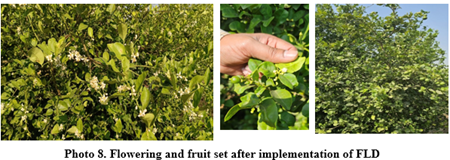
One of the major constraints affecting acid lime cultivation in Vijayapura is the widespread occurrence of nutrient deficiencies, particularly of essential macro- and micronutrients such as nitrogen, phosphorus, boron, iron, manganese and zinc. These deficiencies are largely attributed to the semi-arid climate and inherent soil constraints of the region. Nutrient imbalances adversely affect plant physiology, leading to poor flowering, inadequate fruit set, reduced summer yields and increased susceptibility to sucking pests and mites. As a result, fruit size and juice content decline, lowering market value and causing substantial economic losses to farmers. Traditional cultivation practices, which often overlook integrated nutrient and pest management, further aggravate the problem by contributing to higher fruit drop, inconsistent yields and declining orchard productivity.
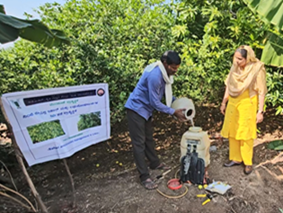
To address these persistent challenges, ICAR–Krishi Vigyan Kendra (KVK), Indi implemented 80 Front Line Demonstrations between 2018 and 2025 across adopted villages in Vijayapura district, covering a total area of 32 ha, with each demonstration laid out on 0.4 ha along with matching control plots. The demonstrations focused on integrated Bahar management for regulated flowering combined with foliar application of Arka Citrus Special, a balanced micronutrient formulation containing zinc, boron, manganese, iron, copper and other essential elements. The technology package included providing adequate irrigation in May followed by light pruning in June, application of 50 ppm GA₃ after pruning to stimulate vegetative growth, spraying Lihocin at 15-day intervals during September for flowering regulation, and monthly foliar sprays of Arka Citrus Special mixed with shampoo sachet and lemon juice starting one month prior to flowering and continuing until harvest. Timely management of sucking pests using recommended insecticides was also an integral component of the intervention.
Alongside demonstrations, ICAR–KVK Indi conducted more than 200 training programmes, organized over 20 field days and provided more than 1,000 on-field and off-field consultations across major lime-growing villages of the district. This comprehensive extension effort enhanced farmers’ awareness, addressed nutrient deficiencies, improved plant resilience against pests and resulted in visible improvements in fruit size, yield and quality, making the approach sustainable and farmer-friendly. However, despite the growing demand for Arka Citrus Special, limited availability in local markets emerged as a major constraint. To overcome this, ICAR–KVK Vijayapura-II (Indi) acquired the production technology licence for Arka Citrus Special from ICAR–IIHR, Bengaluru. With financial support of ₹4.00 lakh from ICAR–ATARI, Bengaluru and ₹6.00 lakh from the Karnataka State Lime Development Board for licence procurement, machinery and training, a dedicated production unit was established on the KVK Indi campus in September 2022. Production began in January 2023, and by August 2025, over 2,700 kg of Arka Citrus Special had been produced and supplied to approximately 1,525 farmers.
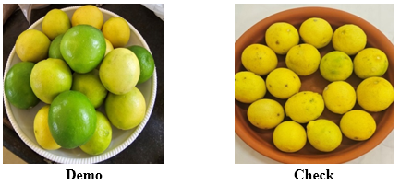
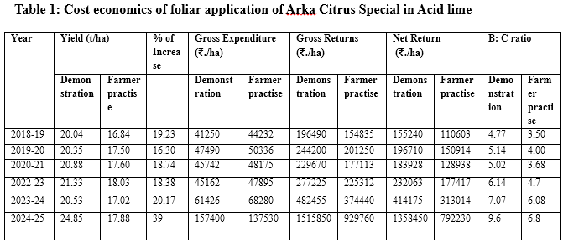
Farmers reported visible improvements within 30 to 45 days of adoption, including reduced fruit drop, enhanced fruit size and colour, higher juice content and better resistance to pests. Demonstration plots recorded an average reduction of 22.5 per cent in nutrient deficiency symptoms and a 15–20 per cent decrease in pest incidence compared to farmers’ practice plots. Yield data from Front Line Demonstrations conducted between 2018–19 and 2024–25 consistently showed superior performance of the improved technology. Demonstration plots achieved yield advantages ranging from 16 to 39 per cent, with yields steadily higher than farmers’ practices and peaking at 24.85 t/ha during 2024–25. On average, demonstrations recorded 21.33 t/ha, along with improved fruit quality fetching a premium of ₹250–500 per 50 kg bag.
Although gross expenditure in demonstration plots was marginally higher, the increase was insignificant compared to the substantial rise in gross returns. Demonstration plots achieved gross returns ranging from ₹1.96 lakh/ha to ₹15.16 lakh/ha over the years, resulting in significantly higher net profits and consistently superior benefit–cost ratios. The B:C ratio improved steadily from 4.77 in 2018–19 to 9.60 in 2024–25, compared to 3.50 to 6.80 under farmers’ practices. These gains were driven by balanced nutrition, effective flowering regulation, improved pest management and strong market demand for premium-quality fruits.
The cumulative multi-year impact confirmed that the integrated technology package not only enhanced yields and profitability but also improved resilience against nutrient deficiencies and pest pressures. Encouraged by the success of the demonstrations, the technology spread rapidly through farmer-to-farmer interactions, extension services and word-of-mouth dissemination. Sales of Arka Citrus Special increased from one quintal in 2022–23 to ten quintals in 2023–24 and crossed sixteen quintals in 2024–25, generating ₹3.2 lakh in revenue during 2024–25 alone. Between September 2022 and August 2025, the technology reached more than 1,525 farmers and covered nearly 214 ha across Vijayapura district and neighbouring areas.
Before intervention, district-level yields averaged 17.48 t/ha with net income of ₹2,78,852/ha and a B:C ratio of 4.79. Post-adoption, average yields increased to 21.33 t/ha with net income of ₹4,23,427/ha and a B:C ratio of 6.3. In peak years, net returns rose by 71.5 per cent, demonstrating transformative economic gains. Additional benefits included reduced dependence on chemical fertilisers by 20–30 per cent, improved soil health, enhanced fruit shelf life and nutritional value, and long-term environmental sustainability through balanced micronutrient management.
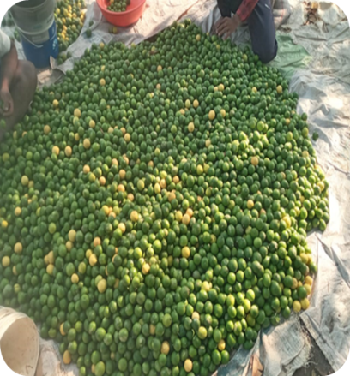
By August 2025, the technology had expanded to 214 ha and benefited 1,525 farmers, with demand for Arka Citrus Special rising steadily from 0.1 tonne in 2022–23 to 1.6 tonnes in 2024–25. The integration of Arka Citrus Special with Bahar management has thus significantly transformed acid lime cultivation in Vijayapura by addressing chronic nutrient deficiencies, regulating flowering and mitigating pest pressures. Supported by a dedicated KVK production unit, extensive demonstrations and sustained farmer outreach, this eco-friendly and economically viable technology has positioned Vijayapura district as a model for citrus innovation in Karnataka, with strong potential for further scaling through cooperative and FPO-led initiatives.
(Source: ICAR-Krishi Vigyan Kendra, Vijayapura-II, Karnataka)





Like on Facebook
Subscribe on Youtube
Follow on X X
Like on instagram