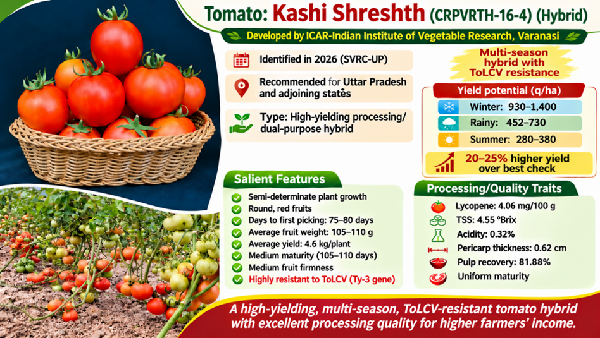
Developed by ICAR-Indian Institute of Vegetable Research, Varanasi, the hybrid combines multi-season adaptability, high yield, virus resistance and superior processing quality
For tomato growers, seasonal uncertainties, disease outbreaks and fluctuating market demands often pose significant challenges to productivity and profitability. Addressing these concerns, ICAR-IIVR, Varanasi, has developed Kashi Shreshth, a high-yielding, multi-season tomato hybrid designed to enhance farmers' returns while catering to both fresh-market consumption and processing industries.
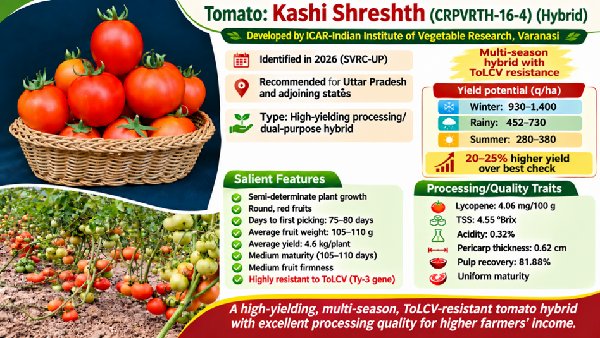
Released by the State Variety Release Committee (SVRC), Uttar Pradesh, in 2026 and submitted to the Central Variety Release Committee (CVRC) for notification, Kashi Shreshth is suitable for open-field cultivation during winter, rainy and summer seasons. Its adaptability across three major growing seasons offers farmers greater flexibility in crop planning and production.
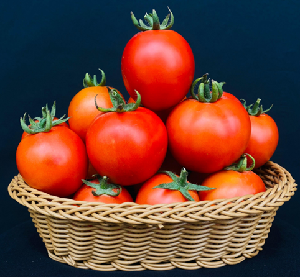
The hybrid produces attractive, round, red fruits weighing 105–110 g on average, making them suitable for fresh-market sales as well as processing. Its yield potential ranges from 930–1,400 quintals per hectare during winter, 452–650 quintals per hectare in the rainy season and 280–380 quintals per hectare in summer. It also offers a 20–25% yield advantage over check hybrids, providing considerable potential to improve farm productivity.
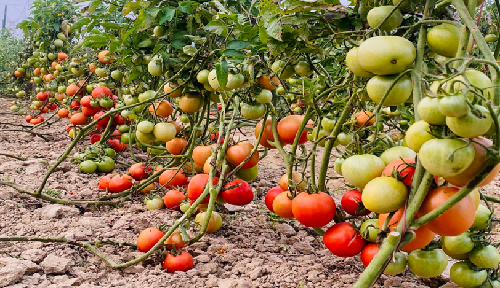
A key strength of Kashi Shreshth is its high resistance to Tomato Leaf Curl Virus (ToLCV), one of the major constraints affecting tomato cultivation, particularly in warmer and humid conditions. Associated with the 'Ty-3' resistance gene, this trait helps protect the crop against virus pressure and supports more stable production across seasons.
Beyond productivity and disease resistance, Kashi Shreshth offers significant advantages in fruit quality and processing suitability. With total soluble solids of 4.55 °Brix, lycopene content of 4.06 mg/100 g and pulp recovery of 81.88%, the hybrid meets important quality requirements for processing products such as sauces, purées and tomato paste, while retaining its appeal in the fresh market. Its high pulp recovery also makes it a promising choice for processing industries.
By combining multi-season adaptability, high yield potential, resistance to Tomato Leaf Curl Virus and superior processing attributes, Kashi Shreshth represents an important advancement in tomato breeding. The hybrid offers farmers an opportunity to diversify production, reduce seasonal risks and access both fresh and processing markets, while supporting the growing demand for quality tomato varieties in the agricultural and food-processing sectors.
(Source: ICAR-Indian Institute of Vegetable Research, Varanasi)