


12 February 2026, New Delhi
Dr M.L. Jat, Secretary (DARE) and Director General (ICAR), delivered a compelling address on transforming India’s agrifood systems on the occasion of the 56th Lal Bahadur Shastri Memorial Lecture in the 64th Convocation Ceremony of ICAR-Indian Agricultural Research Institute, New Delhi. The lecture underscored the need to shift from traditional production-centric models to integrated, resilient agrifood systems capable of delivering health, nutrition, sustainability, and equity for all stakeholders. Dr. Jat emphasized that India’s agriculture must go beyond yield to ensure nutritional security, environmental sustainability, and socio-economic inclusion, aligning with the nation’s vision of Viksit Bharat by 2047. He called for scientific and policy frameworks that integrate soil, plant, animal, human, and environmental health into a cohesive strategy that supports climate resilience and resource-use efficiency. Central to his message was the importance of One Health and systems thinking, recognizing the interdependence of ecosystems, food value chains, and community well-being.
SEHAT (Science Excellence for Health through Agricultural Transformation) underscores the integrated continuum of agriculture, food and nutrition, and health, highlighting that healthy soils and biofortified, diverse crops are central to disease prevention, nutritional security, and overall wellbeing. The initiative reflects a strong ICAR–ICMR collaboration, reinforcing a systems-based approach where agricultural research directly contributes to improved public health outcomes through sustainable and nutrition-sensitive agrifood systems.
Dr. Jat urged researchers, extension professionals, and policymakers to adopt holistic approaches that strengthen food processing, market linkages, digital technologies, and climate-adaptive innovations aimed at optimizing livelihoods of smallholder farmers, women, and youth. He highlighted that agrifood systems must respond to emerging challenges such as malnutrition, micronutrient deficiencies, climate change, and inequitable access to resources, and must harness advances in precision agriculture, biofortification, AI-driven solutions, and sustainable farming practices to achieve this transformation. Dr. Jat reiterated ICAR’s commitment to leading this transition through multi-stakeholder partnerships, demand-driven research, and farmer-centric implementation frameworks, connecting science to ground reality. His lecture also reaffirmed the role of education and capacity building in empowering the next generation of agricultural leaders.
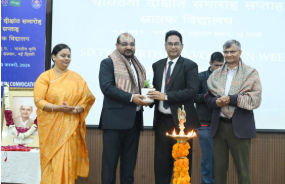
The programme was inaugurated by Shri Sunil Shastri ji through the ceremonial lighting of the lamp. The chairperson of the session, Prof. Ramesh Chand, Member of NITI Aayog, also emphasized that India’s agrifood systems must be reoriented to address both climate challenges and economic realities. He underlined that agriculture contributes significantly to greenhouse gas emissions but also holds untapped potential for carbon sequestration and sustainable resource management, stressing the need for economic analysis that goes beyond traditional price metrics to include natural resource and climate impacts. Prof. Chand highlighted that a multi-stakeholder investment strategy integrating government, private sector, community organizations and financial institutions, is essential to build climate-resilient, nutrition-secure and economically viable food systems for the future.
Dr Ch Srinivas Rao, Director ICAR-IARI while addressing the gathering highlighted that India, once engaged primarily in the fight against hunger, now confronts a more complex challenge of declining public health driven by unhealthy diets. Over 56 per cent of the country’s disease burden is linked to dietary factors.
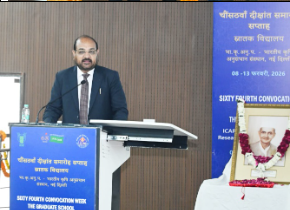
Agriculture must play a role in human health as vital as that of medical science, as present agri-food systems, largely centered on calories and commodities have overlooked nutrition, diversity, and environmental sustainability. Emphasizing that healthy food originates from healthy soils, he pointed to soil degradation, micronutrient deficiencies, and simplified cropping systems such as rice-wheat monocultures as contributors to poor diet quality, biodiversity loss, and climate vulnerability. Highlighting the continuum from soil microbes to the human gut microbiome, Dr Rao emphasized that there is a need for integrated, systems-based solutions and a shift towards sustainable agri-food systems that simultaneously address production, nutrition, environment, and livelihoods to ensure nutrition security, climate resilience, and healthier lives for all.
The event was well-received by scientists, students, policymakers, and farming community representatives, reinforcing the collective quest for a resilient, nutritional, and equitable agrifood future for India.
(Source: ICAR-Indian Agricultural Research Institute, New Delhi)





Like on Facebook
Subscribe on Youtube
Follow on X X
Like on instagram