


Repeat breeding in dairy cattle especially crossbred cows is a widespread reproductive challenge that leads to delayed conception, reduced milk yield, and significant economic losses. Often triggered by nutritional deficiencies, hormonal imbalances, or subclinical infections, this condition severely affects farm profitability. A dairy farmer from Mayem, Bicholim, experienced these setbacks firsthand as several of his crossbred cows repeatedly returned to estrus, resulting in decreased milk production and an estimated financial loss of nearly ₹23,000 per cow each year. The burden of feeding non-productive animals further strained his resources.
Seeking a solution, the farmer approached the scientists of ICAR–Central Coastal Agricultural Research Institute, Goa, for guidance. Following a thorough assessment, the team confirmed that the affected cows were suffering from non-infectious repeat breeding. A combined nutritional and hormonal intervention was initiated. The cows were provided with bypass fat supplementation beginning from the detected estrus, and artificial insemination was planned for the subsequent cycle. Additionally, human Chorionic Gonadotropin (hCG) was administered parenterally on the seventh day post-insemination. While fat supplementation helped restore a positive energy balance and supported optimal ovarian function, the hCG induced the formation of an accessory corpus luteum, enhancing progesterone levels essential for establishing early pregnancy.
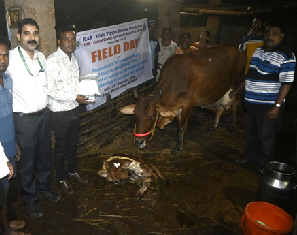
The results were remarkable. Three out of four repeat-breeding cows conceived, achieving a pregnancy rate of 75%. With improved reproductive efficiency, the farm recorded up to a 90% increase in milk production, alongside notable reductions in feed and management costs. The total treatment expenditure amounted to just ₹1,875, while the farm realized an average return of ₹36,000 per cow when compared to untreated repeat-breeding animals.
Motivated by this success, the farmer adopted the same approach across his herd and actively shared the technique with neighboring dairy farmers. Soon, four additional farmers reported similar improvements, with enhanced conception rates and increased milk yields, demonstrating the wider applicability of the intervention.
This case stands as a compelling example of how targeted nutritional and hormonal management can effectively address repeat breeding in crossbred cows, particularly those suffering from negative energy balance and hormonal insufficiencies. The farmer's experience highlights the transformative potential of scientific interventions in strengthening reproductive performance and ensuring sustainable dairy farming.
(Source: ICAR- Central Coastal Agricultural Research Institute, Goa)





Like on Facebook
Subscribe on Youtube
Follow on X X
Like on instagram