


The Dahanu region of Palghar district in Maharashtra is home to predominantly tribal communities, many of whom are small and marginal landholders engaged in traditional fish farming for more than a decade. Despite their long-standing involvement, awareness about scientific and modern aquaculture practices has remained limited, resulting in low productivity and underutilization of available resources.
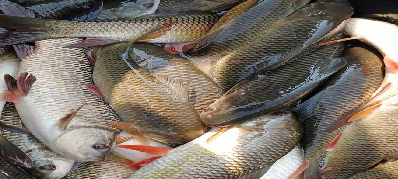
Promoting Scientific Aquaculture through Training and Demonstration
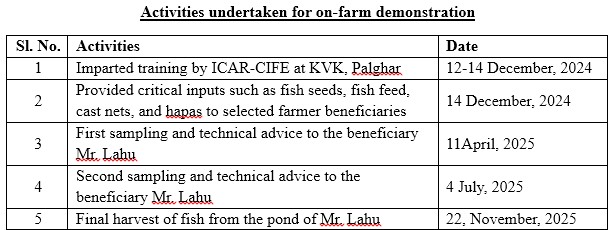
To bridge this gap, the ICAR–Central Institute of Fisheries Education, Mumbai, in collaboration with Krishi Vigyan Kendra (KVK), Palghar, conducted a three-day training-cum-demonstration programme under the Tribal Sub-Plan (TSP) from 12–14 December 2024. The initiative focused on popularizing scientific fish farming among Scheduled Tribe (ST) farmers of the region. As part of the programme, critical inputs including quality fish seed, pelleted feed, cast nets, and hapas were provided to selected beneficiaries possessing their own ponds.
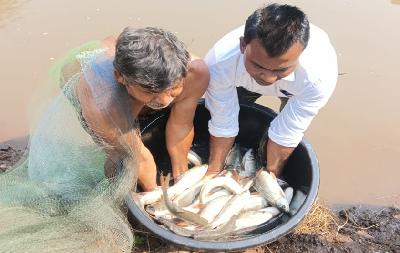
Journey of Transformation: The Success of Mr. Lahu Pandu Choudhari
Among the participants was Mr. Lahu Pandu Choudhari, a tribal farmer from Sukhadamba village in the Saiwan block of Palghar district. Four years ago, he had constructed a small 3-guntha (0.07-acre) pond on his land primarily for irrigation, unaware of its potential for fish culture. He learned about the scientific fish farming programme conducted by ICAR-CIFE at KVK, Palghar, and decided to attend the training.
During the programme, he gained essential knowledge on pond preparation, fish seed stocking, feed formulation and feeding practices, water quality management, and overall scientific culture techniques. As a beneficiary, he received the following inputs to initiate fish farming for the first time in his pond:
• 660 fingerlings of Labeo rohita (4.0 ± 0.2 g)
• 440 kg of pelleted feed
• One cast net and one hapa
From Learning to Implementation
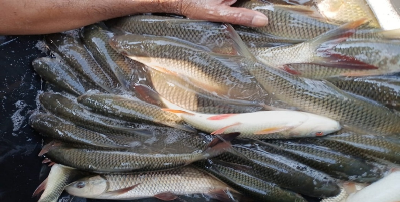
After proper acclimatization, Mr. Choudhari stocked the fish and followed the recommended feeding schedule of twice-daily feeding at 4% of fish body weight. Over an 11-month culture period—including two winter months—he achieved remarkable growth, with individual fish reaching an average weight of 800 g, an impressive outcome for a first-time scientific fish farmer.
Two intermediate samplings were conducted during the culture period to assess growth, monitor fish health, and adjust feeding strategies. Water quality parameters were also analysed to ensure optimal culture conditions. A final sampling at the end of 11 months confirmed excellent growth and survival, culminating in a total production of 0.48 tonnes from just 0.07 acres.
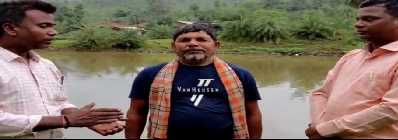
Production, Profitability, and Community Impact
The harvest yielded a gross income of ₹0.96 lakh, calculated at the local market price of ₹200 per kg. After accounting for expenses most of which were covered through the TSP programme inputs Mr. Choudhari realized a net profit of ₹0.70 lakh. Notably, he did not incur any additional expenditure on critical inputs apart from his labour and routine management.
His successful transition from traditional practices to scientific aquaculture has set a powerful example for other small and marginal farmers in the Palghar region. Mr. Choudhari’s story demonstrates how scientific intervention, proper training, and timely institutional support can unlock significant livelihood opportunities for tribal farmers, encouraging sustainable aquaculture adoption across the district.
(Source: ICAR- Central Institute of Fisheries Education, Versova, Andheri, West, Mumbai)





Like on Facebook
Subscribe on Youtube
Follow on X X
Like on instagram