


31 July 2026, Umiam, Meghalaya
Reaffirming its commitment to promoting women-led fisheries and sustainable livelihood development, ICAR–Central Inland Fisheries Research Institute, Barrackpore, distributed cage nets and coracles to 25 tribal women fisher families at Umiam Reservoir, Meghalaya, under its North Eastern Hills and Tribal Sub-Plan (TSP) programmes.
Umiam Reservoir, one of Northeast India's most important inland fishery resources, supports the livelihoods of numerous tribal fishing communities. Through science-driven interventions, ICAR-CIFRI has been transforming fisheries in the reservoir by promoting cage aquaculture, culture-based fisheries, fish stock enhancement, capacity building and scientific resource management. These initiatives have contributed to enhanced fish production, improved livelihood security and increased participation of women in fisheries-based enterprises.
The distribution programmes, organised on 28 and 31 July 2026, were conducted by the ICAR-CIFRI Regional Centre, Guwahati, in collaboration with the Ri-Bhoi Farmers' Union (RFU), Meghalaya, and the Department of Fisheries, Government of Meghalaya. As part of the initiative, six scientifically designed cage nets were distributed to support cage aquaculture, while coracles were provided to improve mobility, operational efficiency and safety for women engaged in cage culture and reservoir fishing.
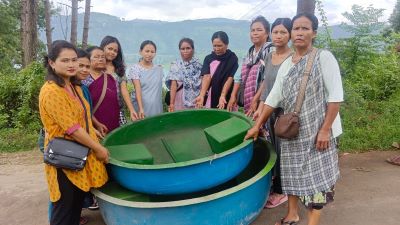
The programme was implemented under the guidance of Dr Pradip Dey, Director, ICAR-CIFRI, in coordination with the Director of Fisheries, Government of Meghalaya.
In his message, Dr Dey reaffirmed ICAR-CIFRI's commitment to empowering tribal and riparian communities through science-based fisheries interventions. He noted that the distribution of cage nets and coracles would strengthen women-led fisheries, promote sustainable livelihoods and enhance the resilience of inland fisheries in the Northeast.
He further observed that integrating modern fisheries technologies with community participation is fostering women-led entrepreneurship and strengthening inland fisheries value chains. Emphasizing the institute's broader vision, he stated that ICAR-CIFRI's interventions are aimed not only at enhancing fish production but also at building resilient fisheries institutions that generate employment, promote resource conservation, foster inclusive economic development in the Northeast and contribute to the national vision of Viksit Bharat 2047.
Addressing the beneficiaries, Shri D. Majaw, President, Ri-Bhoi Farmers' Union, highlighted the long-standing partnership between ICAR-CIFRI and the Union in improving the socio-economic conditions of tribal fishing communities. He appreciated the institute's sustained scientific support, which has significantly enhanced fish production while creating sustainable livelihood opportunities for reservoir-dependent families.
The programme also highlighted ICAR-CIFRI's successful development of cage culture technology specifically suited to the mid-altitude reservoirs of Northeast India. Through participatory approaches, the institute continues to promote cage aquaculture, culture-based fisheries, biodiversity conservation and aqua-tourism, with a special emphasis on empowering tribal women through fisheries-based enterprises.
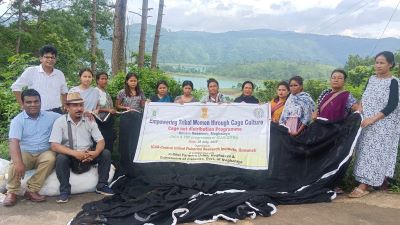
Participants were also demonstrated the standard operating procedures for scientific cage culture and the safe operation of coracles, with emphasis on best management practices and safety measures for reservoir fishing activities.
On behalf of the beneficiaries, appreciation was expressed to ICAR-CIFRI for its continued technical guidance and input support. The beneficiaries noted that the assistance would significantly strengthen the livelihoods of tribal women fishers and encourage greater participation of women in fisheries-based enterprises.
The distribution of cage nets and coracles marks another significant milestone in ICAR-CIFRI's efforts to promote sustainable inland fisheries, strengthen women-led enterprises, enhance fish production and improve the socio-economic well-being of tribal communities in Northeast India through science-based, community-centric interventions.
(Source: ICAR-Central Inland Fisheries Research Institute, Barrackpore, West Bengal)





Like on Facebook
Subscribe on Youtube
Follow on X X
Like on instagram