


1–2 September 2026, Murshidabad
In a significant stride towards inclusive, science-led and sustainable fisheries development, the ICAR-Central Inland Fisheries Research Institute, Barrackpore in collaboration with Dhaanyaganga Krishi Vigyan Kendra, organized a two-day training-cum-fisheries input distribution programme on 1–2 September 2026 at Hatpara under Khargram block of Murshidabad, West Bengal.
The programme was organized under the “Cluster-Based Bata Fish (Labeobata) Culture Programme”, with a focused objective of empowering Scheduled Caste (SC) farmers through scientific aquaculture technologies, skill development, quality inputs and sustained livelihood opportunities. The initiative reflects the institutional commitment to taking fisheries science from laboratories to the last mile, enabling rural communities to transform available aquatic resources into productive and sustainable livelihood assets.
The programme was inaugurated by the MLA of Khargram Assembly Constituency, Mrs. Malati Mal, who encouraged the participating farmers to adopt fisheries as a viable and sustainable livelihood enterprise. She highlighted the potential of scientific fish culture to enhance household income, generate rural employment and improve the socio-economic well-being of farming and fisher communities. She also appreciated the collaborative efforts of ICAR-CIFRI and DGKVK in bringing scientific knowledge and technologies directly to rural communities and emphasized the importance of convergence among scientific institutions, government agencies and local stakeholders for inclusive development.
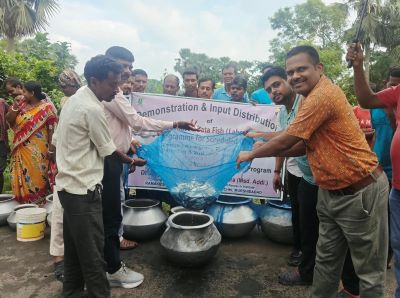
Organised under the guidance of Dr Pradip Dey, Director, ICAR-CIFRI, the programme benefited 50 SC farmers from 12 panchayats of Khargram block. The two-day training focused on practical and scientific aspects of freshwater aquaculture, with special emphasis on Bata fish culture, pond preparation and management, scientific feeding, disease prevention, probiotic application, fish health management and the economic potential of Bata-based aquaculture enterprises.
A key feature of the programme was the provision of quality fisheries inputs to facilitate immediate adoption of the technologies imparted during the training. Each of the 50 participating farmers received 15 kg of Bata fish fingerlings, 35 kg of floating fish feed and 500 g of probiotics. The input support is expected to strengthen field-level adoption, improve fish growth and production efficiency, and provide farmers with an opportunity to translate scientific knowledge into tangible economic outcomes.
In his message, Dr Dey emphasized that the true measure of agricultural and fisheries research extends beyond scientific innovation to its ability to transform lives, create opportunities and empower communities at the grassroots.
He stated: “Our vision is to transform fisheries from technology transfer into technology-led livelihood transformation. By integrating science, quality seed, improved practices and continuous handholding, we aim to build empowered communities and sustainable aquaculture enterprises. With special focus on SC farmers, Khargram can emerge as a model of inclusive fisheries development—where science translates into income, entrepreneurship, employment and dignified livelihoods.”
He further emphasized that cluster-based approaches can create economies of scale, facilitate peer learning, improve access to technology and markets, and strengthen collective action among farmers. Such models, he noted, can serve as replicable pathways for building resilient rural economies through fisheries and aquaculture.
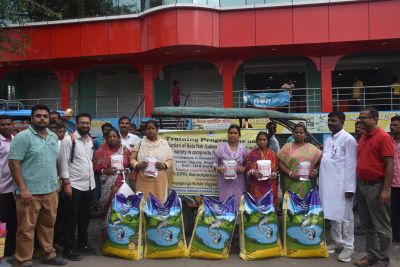
The technical sessions featured expert guidance on scientific freshwater aquaculture, feeding and pond management, disease prevention, probiotic application, and the economic prospects of Bata fish culture.
The interactive sessions enabled farmers to share their field-level experiences, identify production constraints and seek practical solutions from the technical experts. The programme thus created a valuable two-way knowledge interface between science and farming communities, ensuring that research-based recommendations remain relevant to local needs and production realities.
The initiative represents an important step towards building a technology-driven, inclusive and sustainable fisheries ecosystem in Khargram. By integrating scientific expertise, quality inputs, farmer capacity building, local leadership and institutional convergence, ICAR-CIFRI and DGKVK are strengthening the pathway from research to adoption, adoption to productivity, and productivity to sustainable livelihood generation.
The programme reinforces the broader vision of “Science for Society and Prosperity for All”, where fisheries technologies are not confined to laboratories or institutions but become instruments of empowerment, entrepreneurship, employment and sustainable rural development.
(Source: ICAR-Central Inland Fisheries Research Institute, Barrackpore)





Like on Facebook
Subscribe on Youtube
Follow on X X
Like on instagram