


In the dynamic landscape of the agricultural industry, maintaining the freshness and quality of fresh produce presents an ongoing challenge. The journey from farm to table involves numerous variables, including transportation, storage conditions, and handling practices, all of which can significantly impact the shelf life and sensory attributes of fruits and vegetables. Recognizing the critical importance of ensuring monitoring of freshness in fresh produce in real time, our research endeavors have led us to develop an innovative solution: a biobased pH-sensitive indicator tailored specifically for the detection of quality changes of produce freshness.
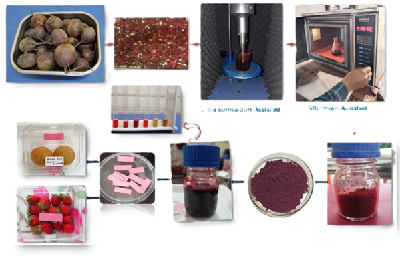
The indicator is based on the principal as pH serves as a fundamental reflection of freshness in many types of food products. As fruits and vegetables undergo natural physiological processes and encounter environmental factors, their pH levels subtly fluctuate. Leveraging this inherent characteristic, the biobased pH-based indicator offers a rapid and reliable method for quality assessment. The indicator consists of natural anthocyanin-based dye extracted from the black carrot peel, betalain pigment from beetroots peel and curcumin pigment from Turmeric (Curcuma longa) rhizomes and coated on a paper as a supporting matrix. The biobased piment dye is coated on the paper and allowed it to dry at 30 ˚C.
The indicator is designed as a compact, easy-to-use strip that can be seamlessly integrated into packaging. Upon exposure to the surrounding environment, the indicator undergoes a color change in response to the volatiles released from the food products. This intuitive visual cue provides consumers and retailers alike with instant feedback on the freshness status of the products. The indicators empower consumers to make informed decisions about their produce purchases. With a quick glance at the color of indicators, buyers can determine whether their food communities are at their peak freshness or nearing the end of their shelf life.
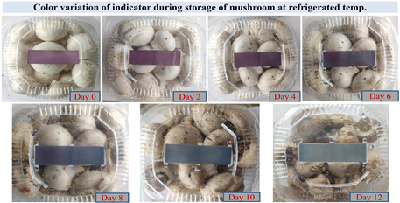
Color change profile of developed freshness indicator during storage of fresh mushroom at 5oC was conducted shown in the figure. At day 0 - pH was 6.25 of mushroom and Indicator color was lavender when it was fully fresh, at day 8 - the pH was 7.83 of mushroom and Indicator color was violet when it was still fresh and at the end of the 12 days - pH exceeded 8.45 of mushroom and Indicator color was dusty blue when it had spoiled.
The color change profile was evaluated during storage for sapota at ambient temperature. On day 1 (pH 5.86), the indicator showed a light-yellow color, indicating full freshness. On day 8 (pH 6.24), the color remained light yellow, confirming acceptable freshness. By day 16 (pH 5.32), the indicator turned light pink, corresponding to spoilage. Thus, the indicator effectively communicates sapota freshness through distinct color transitions.
The beetroot peel-based freshness indicator showed distinct color changes when tested with strawberry at ambient conditions. The paper indicator’s color variation significantly correlated with storage time and pH changes caused by fruit deterioration. These visible transitions effectively reflected freshness levels, demonstrating the indicator’s potential as a simple, eco-friendly, and reliable tool for real-time monitoring of strawberry quality.
Application of natural dye-based indicators for cherry (Prunus avium), blueberry (Vaccinium corymbosum) and jamun (Syzygium cumini) were also found to be effective. These indicators exhibited distinct color changes in response to pH variations during storage, enabling reliable visual assessment of freshness and highlighting their potential for eco-friendly intelligent packaging applications.
The self-stability of biobased pigment indicators varied by form. Powder showed highest stability (up to 4 months) due to low moisture and reduced degradation. Strips had moderate stability (up to 2.5 months).
Biobased pigment indicators provide a cost-effective approach for paper-based pH indicator strips using agro-waste. Raw material cost is minimal, while extraction is the major expense. Estimated cost of production of intelligent indicator for various sources is approximately of Rs. 0.75–1.5 per strip per packet.
(Source: ICAR - Central Institute of Agricultural Engineering, Bhopal)





Like on Facebook
Subscribe on Youtube
Follow on X X
Like on instagram