


24 June 2026, Motihari, Bihar
As part of the nationwide Khet Bachao Abhiyan–2026, ICAR–Mahatma Gandhi Integrated Farming Research Institute, Motihari organized a Farmers–Scientist Interaction and Awareness-cum-Training Programme at Dipua village, Piprakothi Block, East Champaran district, Bihar. The programme focused on green manuring, soil health restoration, balanced fertilizer use, and sustainable nutrient management practices for rice-based production systems.
Scientists and farmers participated in an interactive discussion on practical strategies to reduce excessive dependence on chemical fertilizers while maintaining crop productivity and improving soil health. The programme emphasized the importance of integrating biological nutrient sources, legumes, and organic inputs into existing farming systems.
Farmers were advised to include Dhaincha (Sesbania), green gram, and Azolla as potential biological sources of nitrogen for partial replacement of chemical fertilizers in rice cultivation. Scientists highlighted that a well-grown Dhaincha crop can contribute approximately 50–60 kg nitrogen ha⁻¹, equivalent to nearly 110–130 kg urea ha⁻¹ (about 2.5–3 bags of urea). Besides supplying nitrogen, green manuring improves soil organic matter, microbial activity, nutrient availability, and soil structure.
The programme encouraged farmers and Krishi Sahayak representatives to promote Dhaincha cultivation during the summer season before rice transplantation as an effective and low-cost soil health management practice. The importance of vermicomposting as a source of biofertilizers and organic nutrients for field crops, vegetables, and horticultural crops was also discussed.
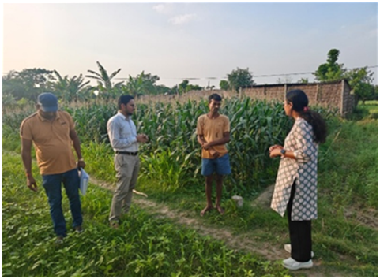
A field visit was conducted in standing maize fields, where scientists provided advisories on balanced fertilizer use, biofertilizer application, and soil-health-centered nutrient management. Farmers were encouraged to integrate organic and inorganic nutrient sources to improve fertilizer-use efficiency and reduce input costs.
Addressing the gathering, the speakers emphasized that inclusion of at least one pulse crop in the annual cropping cycle can significantly improve soil fertility through biological nitrogen fixation while enhancing farm profitability, nutritional security, and sustainability. Farmers were encouraged to adopt green gram and other legumes as integral components of diversified cropping systems.
During the interactive session, farmers expressed keen interest in adopting balanced nutrient management practices. Several participants shared their experiences of cultivating summer green gram and acknowledged its role in reducing nitrogen fertilizer requirements for the succeeding rice crop. Farmers also showed considerable interest in cultivating Dhaincha for green manuring, although timely availability of quality seed was identified as a key requirement for large-scale adoption.
The importance of soil testing before fertilizer application was highlighted, and farmers were encouraged to follow recommended nutrient doses rather than relying on indiscriminate fertilizer use. It was emphasized that balanced fertilization not only improves crop productivity and profitability but also protects soil health, reduces unnecessary expenditure on fertilizers, and enhances nutrient-use efficiency.
The programme concluded with a strong message that healthy soils are the foundation of sustainable agriculture, and that green manuring, pulse inclusion, soil testing, vermicomposting, and balanced nutrient management are essential pathways for achieving productive, profitable, and climate-resilient farming systems.
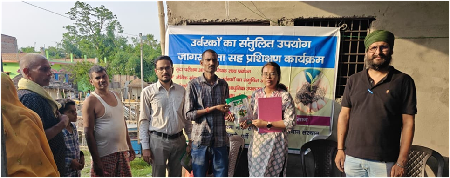
A total of 35 farmers actively participated in the programme. Vegetable seeds of different crops were also distributed among participating farmers to encourage household nutrition and diversified farming.
(Source: ICAR–Mahatma Gandhi Integrated Farming Research Institute, Motihari, Bihar)





Like on Facebook
Subscribe on Youtube
Follow on X X
Like on instagram