


Under the NABARD-funded project "Evaluating the Performance of Multispecies Finfish Culture in Small Low-Cost Ponds for Improving the Livelihood of Farmers in the Salt-Affected Coastal Saline Region of Goa", a fish culture trial and harvest was successfully conducted at the project site in Merces, Goa, in collaboration with the beneficiary farmer, Mr. Joaquim D'Souza. The programme demonstrated the tangible progress achieved in multispecies finfish polyculture under improved, science-based pond management practices in coastal saline conditions. Neighboring farmers were also present during the harvesting event, showing keen interest in adopting similar aquaculture practices. Khazan lands the reclaimed estuarine ecosystems unique to Goa face a confluence of challenges: acidic soil pH, excessive salinity from tidal saltwater intrusion, prolonged fallowing of coastal soils, progressive abandonment of agriculture, dependence on rice monocropping, and declining productivity. Standalone paddy cultivation on these lands is no longer economically viable. Integration of aquaculture into the Khazan farming system offers a scientifically sound pathway to restore productivity, diversify farm output with high-value fish species, and strengthen rural livelihoods. With this objective, polyculture of multiple finfish species was undertaken to enhance aquaculture productivity in saline-affected Khazan ponds through site-specific scientific interventions.
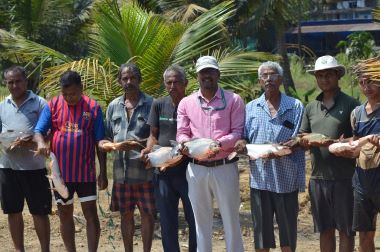
Two freshwater culture ponds with water spread areas of 360 m² (Pond 1) and 300 m² (Pond 2) respectively, were prepared at the project site. The first stocking was carried out on 26 April 2025. Pond 1 was stocked with fingerlings (8-10 cm) of Catla (50), Rohu (50), and Pearlspot (60), while Pond 2 was stocked with Rohu (35), Pacu (60), and Tilapia (60 fingerlings), maintaining a mean stocking density of 0.5 fish/m² in both ponds. A supplementary stocking was undertaken on October 2025 of fingerlings of Pangasius (20) in Pond 1, and Rohu (50) and Pangasius (50) in Pond 2.A partial harvesting was conducted after 329 days of culture (DOC) to assess growth performance and review project progress.
From Pond 1, a total of 80 kg of fish was harvested, comprising 48 kg of Catla, 18 kg of Rohu, and 14 kg of Pangasius. The Pond 2 yielded 62 kg of fish, comprising 23 kg of Pacu and 39 kg of Pangasius. This harvest corresponds to an estimated productivity of approximately 2.2tonnes/ha for Pond 1 and 2.0 tonnes/ha for Pond 2 an encouraging output under the prevailing field conditions. Since this represents only a partial harvest, the final productivity upon complete harvesting is expected to be significantly higher.
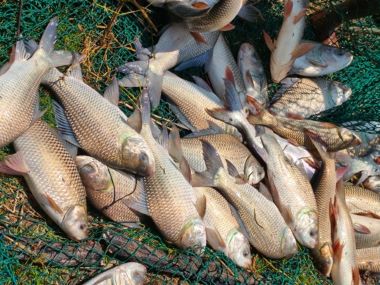
The observed results reflect promising growth performance of major cultured species Pangasius, Catla, Rohu, and Pacu even under saline-affected Khazan conditions, underscoring the resilience and viability of this polyculture model. This demonstration highlights the potential of multispecies finfish culture in small, low-cost ponds as a viable, climate-resilient, and entrepreneurial livelihood option for farmers in the coastal saline ecosystems of Goa. By transforming underutilized Khazan lands into productive aquaculture units, the model offers a replicable pathway for income diversification, food security, and rural entrepreneurship among Goan farming communities.
(Source: ICAR-Central Coastal Agricultural Research Institute, Goa)





Like on Facebook
Subscribe on Youtube
Follow on X X
Like on instagram