


18 & 19 July 2026, Anand
Dr M. L. Jat, Secretary, DARE and Director General, ICAR, visited the ICAR-Directorate of Medicinal and Aromatic Plants Research, Anand, during 18–19 July 2026 to review the Directorate's research programmes, interact with scientists, farmers and entrepreneurs, and provide strategic guidance for strengthening the medicinal and aromatic plants (MAP) sector.
On 18 July, the Director General held an extensive interaction with all the scientists of ICAR-DMAPR. Scientists presented the ongoing research projects and highlighted the progress achieved under various programmes. During the meeting, Dr Jat reviewed project implementation and discussed the importance of Monitoring, Evaluation, Learning and Impact Assessment (MELIA), emphasizing systematic metadata preparation, documentation, and timely updating of research outputs. He advised the scientists to remain prepared for future institutional requirements by ensuring proper data management, effective monitoring and outcome-based reporting.
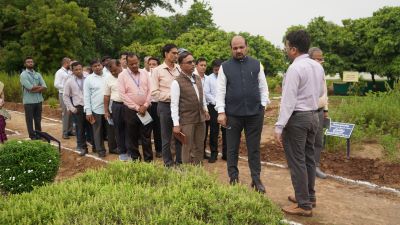
On 19 July, the Director General visited the Directorate's research farms at Lambhvel, Anand, and Boriavi, where he reviewed various field experiments and research activities. As part of the national campaign "One Tree for Mother (Ek Ped Maa Ke Naam)," he planted a Sindoor sapling on the institute campus. He also planted Guggal (Commiphora wightii), a critically endangered medicinal plant of immense medicinal and commercial importance, in the newly established Guggal Block of the Directorate.
During his field visit, Dr Jat inspected the Technology Demonstration Block, Herbal Garden, Giloe Germplasm Block, nurseries and experimental fields, appreciating the efforts made towards conservation, cultivation and technology development in medicinal and aromatic plants.
The Director General also visited exhibitions showcasing improved varieties, production technologies, value-added products and seed samples developed by ICAR-DMAPR. He interacted with incubatees trained under the Directorate's Medi-Hub Incubation Centre, who displayed innovative products and entrepreneurial ventures developed through the institute's technical support and capacity-building programmes.
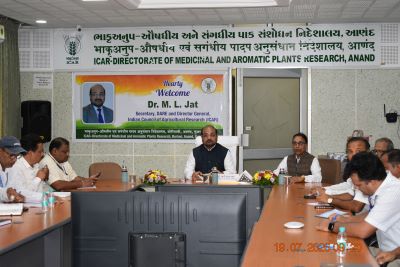
Dr Manish Das, Director, ICAR-DMAPR, welcomed the Director General and presented the Directorate's achievements, growth and future research priorities. The meeting was also attended by scientists from regional ICAR institutes and centres, including ICAR-CIAH, CHES, Godhra; IISWC Regional Centre, Vasad; ICAR-CSSRI Regional Centre, Bharuch; and ICAR-CIFRI Research Station, Vadodara.
During his address, Dr Jat outlined a comprehensive roadmap for future research and institutional development. He emphasized the need to develop a robust Theory of Change framework for research programmes and called for greater focus on high-priority medicinal and aromatic crops through multidisciplinary, team-based research. He reviewed the status of the "One Team–One Task" approach and urged scientists to accelerate collaborative research efforts.
The Director General stressed the preparation of a comprehensive Atlas on Medicinal and Aromatic Plants, incorporating climatic information, cropping systems, production potential and other critical datasets to serve as a valuable national resource. He also reviewed pending externally funded project proposals and assured support wherever intervention from the ICAR headquarters was required.
To promote large-scale adoption of MAP cultivation, Dr Jat proposed the development of two model villages each in Gujarat and Rajasthan, where medicinal and aromatic plants would be cultivated extensively with active participation of a large number of farmers to create saturation models for replication elsewhere.
Describing medicinal and aromatic plants as a "goldmine" for Indian agriculture, he highlighted their enormous potential for enhancing farmers' income, generating rural employment and contributing significantly to the national economy. He particularly advocated the promotion of natural farming-based cultivation of medicinal and aromatic plants, especially among Scheduled Tribe (ST) farmers, as a sustainable pathway for livelihood enhancement and ecological conservation.
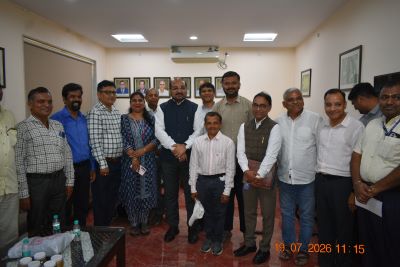
Dr Jat urged all scientists to devote adequate time and attention to planning, monitoring, evaluation and effective execution of research programmes so that every initiative reaches its logical conclusion and delivers measurable impact.
The Director General also interacted with farmers, entrepreneurs and start-ups associated with ICAR-DMAPR. Participants shared their experiences on how training programmes, quality planting materials, seeds, technical guidance and continuous support from the Directorate had helped them establish successful enterprises and expand medicinal plant cultivation, including among tribal farming communities practicing natural farming. Appreciating these success stories, Dr. Jat expressed satisfaction with the Directorate's contributions towards research, technology dissemination and entrepreneurship development.
While commending the remarkable achievements of ICAR-DMAPR, Anand, Dr Jat emphasized that much greater efforts would be required to fully harness the immense potential of the medicinal and aromatic plants sector. He called upon the scientific community to work with renewed commitment and innovation so that the sector can make a significant contribution towards realizing the vision of Viksit Bharat 2047.
(Source: ICAR-Directorate of Medicinal and Aromatic Plants Research, Anand, Gujarat)





Like on Facebook
Subscribe on Youtube
Follow on X X
Like on instagram