


The saying “Nothing succeeds like success” aptly captures the remarkable journey of Shri Subash Chander (48), a landless entrepreneur from the OBC community, and Shri Rishi Kumar (46), a Scheduled Caste farmer owning 0.93 ha of land. Both were employed as marketing representatives in a private agri-input company. Motivated by a shared commitment to sustainable agriculture and rural development, they resigned from their jobs in 2011 to establish Shri Paras Enterprises, a vermicompost production unit at Ratanpura village, Hanumangarh district, Rajasthan.
From Modest Beginnings to Entrepreneurial Resolve
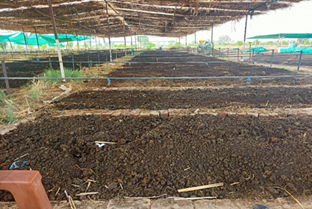
The enterprise began modestly in a leased facility at the RIICO Industrial Area, Ratanpura, with limited manpower and financial resources. Initially, 25 vermi-beds (4 × 20 ft each) were established, utilizing approximately 27 tonnes of cow dung per production cycle. With four production cycles annually, the unit produced about 125 tonnes of vermicompost per year. Of this, 95 tonnes were sold in loose form at ₹4,500 per tonne, while 30 tonnes were marketed in packaged form at ₹7,500 per tonne. Although marketing challenges and sustainability concerns posed early hurdles, the entrepreneurs remained steadfast in their vision.
KVK Intervention: A Defining Milestone
A major turning point came in August 2014, when the entrepreneurs approached KVK Hanumangarh-I. Under the guidance of Dr Anoop Kumar, Head, KVK, along with Dr Kuldeep Singh, SMS (Extension Education) and Shri Umesh Kumar, SMS (Plant Protection), they participated in an on-campus training programme on “On-Farm Bio-input Production” in February 2015.
The training proved transformative. The entrepreneurs adopted scientific vermicompost production practices and diversified into vermi-wash production and earthworm multiplication. They also initiated an intensive farmer outreach programme, personally engaging with 30–35 farmers daily through farm and home visits to promote organic farming. This farmer-centric extension approach significantly boosted demand for their products.
Expansion through Technology and Skill Development
Encouraged by increasing demand, the enterprise expanded operations in February 2018 by leasing 0.75 ha of land at an annual rent of ₹1.1 lakh. The number of vermi-beds increased from 25 to 66, and the unit engaged three permanent labourers, along with seasonal workers. Within six months, the bed capacity further expanded to 88.
In 2019, both partners completed a 200-hour ASCI-certified training programme on “Jaivik Kheti and Vermicompost Production Technology” at SKRAU, Bikaner, significantly strengthening their technical expertise. Subsequently, the enterprise expanded to 142 vermi-beds, substantially enhancing production capacity.
Formalization, Branding, and Sustainability
With continued technical support from KVKs and SKRAU, Bikaner, the entrepreneurs approached the Department of Agriculture, Government of Rajasthan, and obtained manufacturing and marketing licenses in June 2022. They formally launched their brand “Green Vision”, marking a critical milestone in enterprise formalization and market recognition.
Further expansion included leasing an additional 0.25 ha of land at 12 SBN, Hanumangarh Road, at an annual rent of ₹25,000, where 104 new vermi-beds were established. To ensure long-term sustainability, an earthworm reproduction unit with 10 large beds (4 × 30 ft) was initiated in March 2025, enabling in-house availability of quality earthworms.
Production, Marketing, and Financial Growth (2024–25)
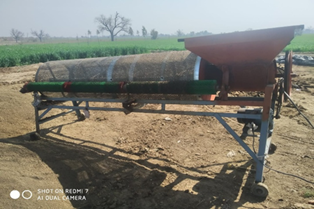
From an initial production of 125 tonnes in 2011, the enterprise achieved nearly a 15-fold increase, producing 1,770 tonnes of quality vermicompost during 2024–25, with seven production batches annually.
Products are marketed in diverse packaging options ranging from 2 kg to 50 kg bags, in addition to loose bulk sales, catering to a wide clientele including indoor and balcony gardeners, kitchen gardens, lawns, orchards, and field crop farmers. Approximately 50% of production is sold in packaged form, while the remaining 50% is sold loose.
Pricing structure:
• 2 kg packs: ₹15 per kg
• 50 kg bags: ₹7 per kg
• Bulk sales: ₹4.5 per kg
Additional products include:
• Vermi-wash: 500 litres @ ₹110 per litre
• Earthworms: 0.5 tonnes @ ₹190 per kg
The enterprise’s annual turnover increased from ₹6.25 lakh in 2011 to over ₹70 lakh, reflecting strong financial growth and market acceptance.
Capacity Building and Farmer Outreach
With continued support from KVKs, Green Vision Enterprises has conducted training programmes for 55 farmers across Rajasthan, Punjab, and Haryana. The enterprise provides free extension services, including farm visits, vermicompost unit setup advisory, and technical troubleshooting, establishing a highly effective farmer-to-farmer extension model.
Impact and Recognition
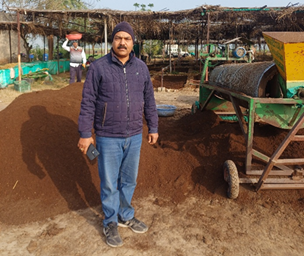
Shri Paras Enterprises has facilitated the establishment of 25-bed vermicompost units, supplied quality earthworms, and supported the organic transition of over 1,000 farmers, who are now regular users of “Green Vision” inputs. The enterprise currently provides employment to more than a dozen rural youth, contributing significantly to livelihood generation in the region.
Their journey demonstrates how grassroots entrepreneurship, when strengthened by scientific training, institutional backing, and strong extension linkages, can evolve into a scalable and sustainable agribusiness model catalyzing an organic farming movement across multiple states.
Key Learnings
• Scientific training and consistent mentoring by KVKs significantly enhance entrepreneurial confidence and technical competence.
• Farmer-to-farmer outreach and on-field demonstrations are effective strategies for promoting organic inputs.
• Product diversification through vermi-wash and earthworm units improves sustainability and income stability.
• Branding, licensing, and formalization are essential for scalability and long-term market credibility.
Future Plans
Shri Paras Enterprises plans to:
• Further expand vermi-bed capacity and explore export opportunities.
• Launch farmer-friendly mobile-based advisory services.
• Collaborate with agri-startup accelerators for technological integration in organic input management.
Today, Green Vision stands as a compelling example of how dedication, scientific knowledge, and extension support can transform an idea into a thriving enterprise benefiting farmers, the environment, and rural communities alike.
(Source: KVK, Hanumangrh-I, Rajasthan and ICAR-Agricultural Technology Application Research Institute Jodhpur)





Like on Facebook
Subscribe on Youtube
Follow on X X
Like on instagram