


Dragon fruit (Hylocereus spp.) cultivation has witnessed rapid expansion across India, particularly in Karnataka, Maharashtra, Gujarat, Andhra Pradesh, Telangana, Tamil Nadu, and West Bengal. While the crop offers high economic returns and growing market demand, it remains extremely vulnerable to sunburn injury during peak summer months when ambient temperatures frequently exceed 36–40 °C. Owing to its Crassulacean Acid Metabolism (CAM) physiology, dragon fruit closes its stomata during daytime, restricting evaporative cooling and making the cladodes highly susceptible to heat stress. This often results in chlorophyll degradation, cellular damage, pathogen attack, reduced flowering and fruit set, and substantial yield losses.
Recognizing sunburn as a major climate-induced constraint to sustainable dragon fruit production, ICAR–Indian Institute of Horticultural Research, Bengaluru undertook comprehensive, multi-year research during 2023–2025 to develop a low-cost, scalable, and farmer-friendly mitigation strategy.
Traditionally, farmers relied on green shade nets, intermittent irrigation, high-dose kaolin sprays (5–10%), or, in many cases, no protection at all. These approaches provided only partial relief and failed to prevent critical damage such as cladode yellowing and bleaching, increased lipid peroxidation (MDA levels), cracking of epicuticular wax, reduced flowering and fruit set, and a higher incidence of stem canker and rot under heat stress. During peak summer months (March–June), yield losses ranging from 30–60% were commonly reported.
To address these challenges, IIHR scientists developed and field-validated an innovative, integrated sunburn mitigation technology that combines a reflective kaolin-based particle film with targeted bio-stimulants and microbial support. The technology consists of kaolin (5%) to reflect excess UV and infrared radiation and reduce canopy temperature; seaweed extract (0.5%) to enhance osmotic balance, antioxidant defence, and stress tolerance; Arka Neem Soap (0.5%) to improve film adhesion, provide bioprotective effects, and reduce secondary infections; and Arka Microbial Consortium (PGPR) (0.5%) to enhance nutrient uptake, root health, and hormonal balance under heat stress.
This integrated formulation was rigorously evaluated on red-pulp (CHESH-D1) and white-pulp (CHESH-W1) dragon fruit genotypes at IIHR using advanced tools such as thermal imaging, chlorophyll estimation, antioxidant profiling, scanning electron microscopy (SEM), and principal component analysis (PCA)-based trait evaluation.
The results demonstrated substantial physiological, biochemical, and structural protection. Canopy temperature was reduced by 4.2–5.1 °C, with the maximum reduction observed under the kaolin plus neem soap treatment. Sunburn incidence declined by 60–76%, and up to 80% when kaolin sprays were combined with shade nets. Chlorophyll content increased by 60–83%, indicating strong protection of the photosynthetic apparatus. Lipid peroxidation, measured as MDA content, declined by up to 64%, reflecting enhanced membrane stability. Antioxidant enzyme activities (SOD, POD, CAT) showed a 1.5–3.4-fold reduction, signifying a lower oxidative stress burden. SEM imaging confirmed intact epicuticular wax layers and turgid stomata in treated plants, in contrast to fractured wax and flaccid stomata observed in untreated controls. Additionally, stem canker and rot incidence were reduced by 30–50% due to improved surface integrity and the antimicrobial effect of neem.
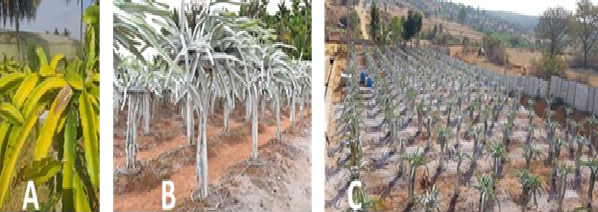
Genotype-specific responses were also evident. The red-pulp genotype CHESH-D1 exhibited higher inherent heat tolerance, while the white-pulp genotype CHESH-W1 benefitted significantly from physical protectants such as kaolin, neem soap, and shade nets.
The technology was subsequently demonstrated in farmers’ fields across Karnataka, including Tumakuru, Ramanagara, Kolar, Bengaluru Rural, and Chikkaballapur, and later expanded to Maharashtra, Gujarat, Telangana, and Andhra Pradesh. To date, over 1,000 farmers in Karnataka have adopted the IIHR sunburn mitigation technology, with rapid uptake reported in Tamil Nadu and West Bengal as well.
Farmers reported a 40–60% reduction in sunburn damage, a 20–30% increase in fruit set, one to two additional flowering flushes, and yield gains of 30–50% (equivalent to 5–7 t ha⁻¹). The technology also enabled a 20–25% reduction in plant protection chemical use, resulting in improved fruit quality and environmental sustainability. Overall, farmers experienced an income enhancement of ₹1.5–3.0 lakh per hectare.
Economically, the technology proved highly attractive, with a seasonal cost of ₹3,000–4,500 per acre, compared to ₹1–1.5 lakh per acre required for permanent shade structures. The benefit–cost ratio ranged from 2.0 to 2.4, depending on region and planting density, making it suitable for both new orchards and existing plantations.
ICAR-IIHR recommends applying kaolin (5%) + seaweed extract (0.5%) + Arka Neem Soap (0.5%) + Arka Microbial Consortium (0.5%) as a foliar spray two to three times during peak summer (March–June) at intervals of 20–25 days. Early-morning application ensures better coverage and maximum protective efficacy.
In conclusion, the ICAR–IIHR kaolin-based reflective film and biostimulant technology represents a scientifically validated, climate-resilient solution for managing sunburn in dragon fruit. By integrating physical shielding, biochemical stress mitigation, and microbial enhancement, it significantly improves plant health, yield stability, and farmer profitability. Its widespread adoption across multiple states highlights its scalability, reliability, and critical role in supporting India’s expanding dragon fruit sector under changing climatic conditions.
(Source: ICAR–Indian Institute of Horticultural Research, Bengaluru)





Like on Facebook
Subscribe on Youtube
Follow on X X
Like on instagram