


Arid and semi-arid regions are increasingly challenged by erratic rainfall patterns, extreme temperature regimes, and chronically low soil moisture availability, resulting in poor crop establishment and low productivity. At the same time, livestock-based production systems in these regions generate substantial quantities of liquid waste, particularly urine, which largely remains unutilized and may pose environmental concerns if improperly managed. Addressing both constraints, a scientific study was undertaken to evaluate camel urine as a sustainable and low-cost seed priming agent for key arid crops.
The study focused on cluster bean (Cyamopsis tetragonoloba), moth bean (Vigna aconitifolia), and pearl millet (Pennisetum glaucum), which are important dual-purpose crops supporting both food and fodder security in arid ecosystems. Results revealed that seed priming with undiluted camel urine for a duration of two hours significantly enhanced germination percentage, seedling vigour, early crop establishment, and overall growth performance under hot arid conditions.
Physiological and biochemical analyses demonstrated that camel urine priming markedly improved plant water relations, membrane stability, antioxidant enzyme activity, nitrogen assimilation, and photosynthetic pigment content. These improvements strengthened stress tolerance mechanisms and enhanced resource-use efficiency, particularly under moisture-stressed environments. The physiological advantages were effectively translated into higher seed yield, improved water-use efficiency, enhanced guar gum content in cluster bean, and superior fodder quality across crops.
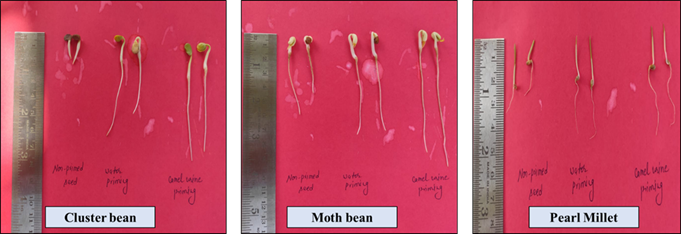
Importantly, the performance of camel urine priming was found to be comparable, and in some cases marginally superior, to commonly used chemical seed priming agents such as potassium nitrate and potassium sulphate. This establishes camel urine as a viable alternative to synthetic inputs for enhancing crop performance in arid regions.
The study highlights camel urine as a low-cost, locally available, and eco-friendly biostimulant that can substantially reduce dependency on synthetic agrochemicals while improving crop productivity. Recycling camel urine for agricultural use not only enhances input-use efficiency but also provides a safe and productive pathway for livestock waste utilization, strengthening crop–livestock integration in arid production systems.
Overall, the findings present a practical, scalable, and climate-resilient seed priming technology with strong potential for adoption in fragile arid and semi-arid ecosystems. By simultaneously improving crop performance, reducing production costs, and promoting sustainable waste recycling, camel urine–based seed priming offers a promising solution for enhancing the resilience and profitability of dryland agriculture.
Impact Highlights
The technology has led to the development of an indigenous, low-cost seed priming strategy tailored for arid regions. It enables scientific utilization of livestock waste, minimizes environmental pollution, and strengthens crop–livestock integration. Farmers can achieve improved crop productivity and water-use efficiency under moisture stress while significantly reducing dependence on chemical inputs and lowering overall production costs.
(Source: ICAR- National Research Centre on Camel, Bikaner)




Like on Facebook
Subscribe on Youtube
Follow on X X
Like on instagram