


A Transformational Intervention by ICAR–Krishi Vigyan Kendra, Tumakuru
Seed is a critical input in agriculture, and the availability of quality seed plays a decisive role in enhancing farm productivity and income. Public sector research institutes such as the ICAR–Indian Institute of Horticultural Research, Bengaluru, have released numerous high-yielding vegetable varieties and hybrids with superior traits. However, unlike field crops, vegetable seed multiplication is undertaken by very few government agencies, resulting in limited availability of quality seed for farmers.
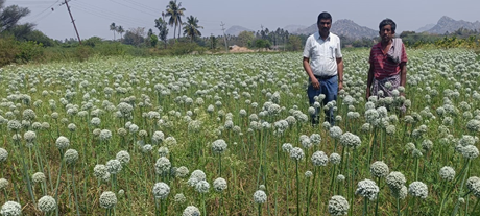
Recognizing this gap, ICAR–Krishi Vigyan Kendra (KVK), Hirehalli, Tumakuru, under ICAR-IIHR, initiated a participatory vegetable seed production programme to ensure large-scale multiplication of quality vegetable seeds through farmer involvement.
Intervention
The programme was initiated during 2015–16 in Marutipura village of Madhugiri taluk, Tumakuru district, Karnataka. At the time of intervention, most farmers cultivated finger millet, pigeon pea, and vegetables for direct market sale, with income often affected by price fluctuations, climatic risks, and rising input costs.
KVK scientists conducted farmers’ group meetings, awareness programmes, and field days to sensitize farmers about the economic potential of vegetable seed production. To ensure smooth and transparent implementation, a Memorandum of Agreement (MoA) was signed between the participating farmers and the KVK, defining procurement rates and operational modalities. As per the agreement, seeds produced by farmers were procured by KVK, processed at the KVK facility, and distributed to other needy farmers.
Transforming a Village Beyond Commercial Crop Cultivation
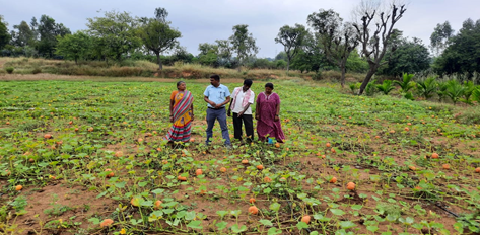
Initially adopted by a few progressive farmers, the seed production initiative soon evolved into a successful alternative enterprise. Farmers were trained in scientific seed production practices such as maintaining isolation distance, rouging, and genetic purity. Within two cropping seasons, participating farmers realized 25–40 per cent higher income compared to conventional commercial crop cultivation.
A key advantage of the programme was the assured buy-back arrangement by KVK. Unlike commercial crops subjected to volatile market prices, seed producers received fixed procurement rates, eliminating marketing risk. Farmers who earlier earned around ₹40,000 per acre from commercial crops began earning ₹65,000–₹80,000 per acre through seed production. Prompt payments and assured markets encouraged more farmers to adopt the practice.
Improved Skills and Technology Adoption
Seed production required adherence to scientific crop management, leading to enhanced technical competencies among farmers. They adopted:
Quality foundation seeds
Precise fertilizer and nutrient scheduling
Careful rouging and field monitoring
Strict maintenance of crop purity and field hygiene
These improved practices not only benefited seed production but also enhanced productivity in their regular farming operations.
Employment Generation and Community Participation
The initiative generated additional employment opportunities within the village:
Women’s self-help groups participated in seed grading and cleaning
Rural youth assisted in field inspections, pollination, and processing activities
Local labourers gained seasonal employment during seed production and processing stages
Gradually, seed production became a community-driven enterprise, fostering cooperation and collective growth.
Recognition and Expansion
With consistent success, Marutipura village gained recognition as a vegetable seed production hub. Agricultural universities and seed companies initiated collaborations with farmers, leading to:
Expansion in the number of crops and varieties under seed production
Increase in area under seed production from 4 acres initially to nearly 250 acres
Organization of training programmes for new and interested farmers
Impact on Village Economy
The shift from commercial crop cultivation to seed production resulted in significant socio-economic transformation:
Average annual household income (3 acres average holding) increased from ₹1.5 lakh to ₹4.5 lakh
Farmers invested in better farm equipment and livestock
Improved repayment capacity and financial stability
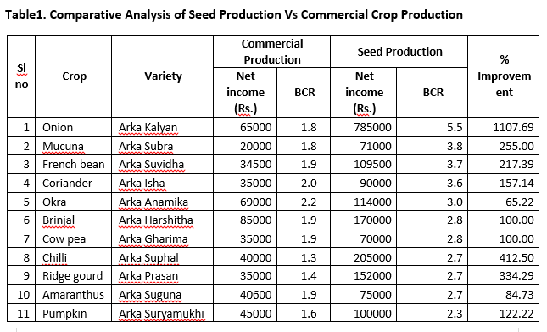
Economic analysis revealed that seed production offered substantially higher returns, with an average Benefit–Cost (BC) ratio of 3.05, compared to 1.77 for commercial crop cultivation. Among various crops, onion seed production recorded the highest BC ratio (4.5), followed by ridge gourd, bottle gourd, chilli, and French bean.
Conclusion
The success of participatory vegetable seed production in Marutipura village clearly demonstrates its potential as a game-changing livelihood option for farmers. With higher and assured returns, enhanced technical skills, employment generation, and strong institutional support, seed production has emerged as a stable and profitable enterprise. The collective efforts of farmers, supported by ICAR–KVK Tumakuru, transformed a simple initiative into a remarkable success story—one that continues to inspire replication across the region.





Like on Facebook
Subscribe on Youtube
Follow on X X
Like on instagram