


18 July 2026, New Delhi
A farmer-scientist interaction and input distribution programme on “Integrated Management of African Giant Snails” was successfully organized under the sponsorship of ICAR–National Research Institute for Integrated Pest Management, New Delhi, and hosted by Vidya Bhawan Krishi Vigyan Kendra, Udaipur at Bichhiwara village, Phalasiya, Udaipur, Rajasthan, today. The event brought together-r scientists, policymakers, and farmers to address the growing menace of the African giant snail, which has posed a serious challenge to agriculture in the Bichhiwara village for the past three years.
The Chief Guest of the programme, Shri Babu Lal Kharadi, Cabinet Minister, Tribal Area Development and Home Guards Department, Government of Rajasthan, encouraged farmers to adopt modern scientific practices and remain connected with agricultural extension services.
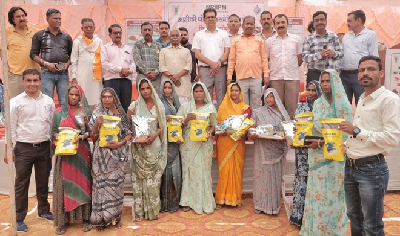
The experts elaborated on the snail infestation problem, while the keynote scientific lecture highlighted the biology, damage potential, and integrated pest management (IPM) strategies for snail control, emphasizing mechanical, biological, and chemical approaches. They explained that the African giant snail is highly polyphagous, causing severe damage to maize, vegetables, pulses, and fruit crops. The IUCN has listed it among the world’s 100 most dangerous invasive species. Collect snails by hand using gloves in the morning and evening, remove eggs from the soil and destroy them, and immerse snails in salt or lime solution to kill them.
Place yeast mixed water or jaggery yeast solution in the field to attract and eliminate snails. Use ducks and conserve natural enemies such as birds and frogs. Apply Metaldehyde (2.5% or 5% granules), iron phosphate, copper sulfate, salt, and lime. Special precautions were also stressed for keeping chemicals away from children and livestock, avoiding application before rainfall, and using only registered products. The snail's life cycle consists of four stages: egg, juvenile, sub-adult, and adult. Under favourable conditions, it reproduces rapidly and can survive for 3–5 years. Common signs of infestation include holes in leaves, destruction of new shoots, scraping marks on fruits, and the presence of slime trails in the field.
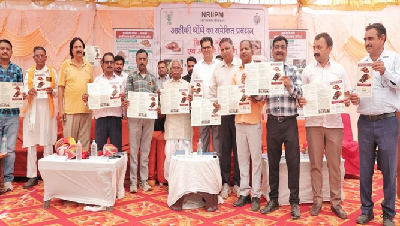
A scientific folder on “Management of African Snails” was released during the event, and essential inputs including Metaldehyde (340 kg), lime (3200 kg), and salt (1000 kg) were distributed among farmers. The programme witnessed active participation of more than 250 farmers, who benefited from practical demonstrations and expert guidance.
All the dignitaries expressed their gratitude to Dr M.L. Jat, Secretary, DARE & DG, ICAR; Dr Poonam Jasrotia, ADG (PP&B), ICAR; and Dr R. Thangavelu, Director, ICAR-NRIIPM, New Delhi, for providing financial assistance of ₹6.25 lakh and training support for the snail management project. On this occasion, the Minister Shri Babulal Kharadi also announced a contribution of ₹5 lakh from his own funds towards the snail management project.
(Source: ICAR–National Research Institute for Integrated Pest Management, New Delhi)





Like on Facebook
Subscribe on Youtube
Follow on X X
Like on instagram