


14 October 2026, Motihari, Bihar
ICAR–Mahatma Gandhi Integrated Farming Research Institute, Motihari, Bihar, organised an educational exposure visit for fourth-year students of Tirhut College of Agriculture (TCA), Dholi, under Dr Rajendra Prasad Central Agricultural University (RPCAU). The visit aimed to enhance students’ practical knowledge of soil testing, laboratory analytical techniques, fisheries management and integrated farming systems (IFS), with particular emphasis on sustainable agricultural practices suitable for waterlogged and low-lying areas of eastern India.
The programme provided students with an opportunity to bridge the gap between theoretical knowledge and practical application through laboratory demonstrations, scientific interactions and field visits. The exposure highlighted the role of scientific research and integrated resource management in improving soil health, enhancing resource-use efficiency and promoting sustainable agricultural production.
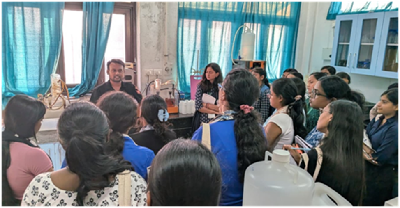
During the visit to the Soil Testing Laboratory, the students were familiarised with various laboratory instruments, their operating principles and applications in soil fertility assessment. He emphasised the importance of scientific soil testing in promoting balanced fertilisation, efficient nutrient management and sustainable crop production. A hands-on demonstration of potassium estimation using a flame photometer enabled the students to understand the analytical procedure and its relevance in assessing soil nutrient status. The session also highlighted the importance of accurate soil analysis in developing site-specific nutrient recommendations and supporting informed agricultural decision-making.
The students subsequently visited the Fisheries Laboratory, where they were introduced to the laboratory facilities and explained key aspects of fish health management, water-quality monitoring and scientific aquaculture practices. The interaction underscored the importance of maintaining optimal aquatic conditions for fish production and highlighted fisheries as a complementary enterprise in integrated farming systems. Discussions also focused on the potential of fisheries-based diversification to enhance farm productivity, strengthen livelihood opportunities and improve the utilisation of water-abundant agricultural landscapes.
A major highlight of the visit was the field exposure to integrated farming system models developed at ICAR-MGIFRI for waterlogged and low-lying areas. The students observed the Rice–Fish–Duck integrated farming system and land-shaping-based IFS models, gaining practical insights into the integration of crop production, fisheries and livestock with efficient land and water management.
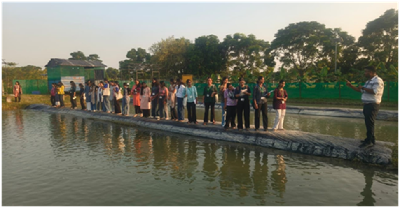
The field demonstrations illustrated how appropriate land shaping, enterprise diversification and recycling of farm resources can improve the productive utilisation of waterlogged lands. The students also learned about selecting complementary farming enterprises based on local hydrological conditions, resource availability and farm-specific requirements. These models demonstrated the potential of integrated farming approaches to enhance resource-use efficiency, improve farm productivity and strengthen resilience under challenging agroecological conditions.
Throughout the programme, the students actively interacted with the institute’s scientists, discussed laboratory procedures and explored the practical applications of agricultural research. The visit reinforced their understanding of the interrelationships among soil fertility management, aquatic resource utilisation and diversified farming systems, emphasising the importance of interdisciplinary approaches to addressing contemporary agricultural challenges.
The educational exposure visit reaffirmed the importance of experiential learning, scientific skill development and strong research–education linkages in agricultural education. Through such initiatives, ICAR-MGIFRI continues to contribute to capacity building among agricultural students and promote the adoption of sustainable, resource-efficient and climate-resilient farming technologies suited to the agroecological conditions of Bihar and eastern India.
(Source: ICAR–Mahatma Gandhi Integrated Farming Research Institute, Motihari, Bihar)





Like on Facebook
Subscribe on Youtube
Follow on X X
Like on instagram