

7-9 October 2026, Motihari, Bihar
ICAR–Mahatma Gandhi Integrated Farming Research Institute, Motihari, Bihar, organised a three-day residential training programme on “Improved Crop Management in Diara/Chaur Lands after Post-Flood Conditions” from 7-9 October 2026, sponsored by Bihar Agricultural Management and Extension Training Institute (BAMETI), Patna. The programme aimed to strengthen technical knowledge and practical skills in post-flood crop recovery, sustainable land and water management, crop diversification and climate-resilient farming systems suited to Bihar’s flood- and waterlogging-prone ecosystems.
The programme was inaugurated on 7 October 2026 in the presence of Dr Raghavendra Singh, Director, ICAR-MGIFRI, and Dr D. P. Dhir, Deputy Project Director, ATMA. The inaugural session commenced with ceremonial lamp lighting, followed by a welcome of the participants and an introductory interaction on the objectives and expected outcomes of the training.
Dr Singh highlighted the challenges posed by recurrent flooding, prolonged waterlogging and uncertain water recession in Bihar's Diara and Chaur ecosystems. He emphasised that post-flood agricultural recovery requires location-specific crop planning, efficient use of residual soil moisture, improved soil health, timely crop establishment and diversification of farming enterprises. He encouraged participants to promote climate-resilient technologies, including zero-tillage, suitable short-duration crops, integrated nutrient management and farming systems that combine crop, livestock and aquatic resources. He further stressed the importance of translating scientific knowledge into practical, farmer-oriented solutions for improving productivity, profitability and livelihood resilience.
The technical sessions covered a broad range of post-flood crop and natural resource management strategies, including flood behaviour and weather-based agricultural advisories, assessment of crop and soil damage, contingency crop planning, post-flood land preparation, soil health restoration and soil carbon enrichment. Special emphasis was placed on crop diversification, conservation agriculture, zero-tillage, balanced fertilisation, efficient irrigation and weed management, and integrated pest and disease management to improve resource-use efficiency and support timely agricultural recovery.
The programme also highlighted the importance of integrated farming systems (IFS) for productive utilisation of flood-affected and seasonally waterlogged lands. Participants were introduced to opportunities for integrating field crops, horticulture, fisheries and organic-resource recycling according to local land elevation, water availability and duration of inundation.
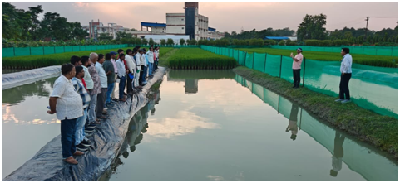
Discussions focused on converting flood-related production constraints into opportunities through appropriate land-use planning and diversified farming enterprises. To strengthen practical understanding, field exposure visits were organised at the ICAR-MGIFRI research farm and Krishi Vigyan Kendra (KVK), Piprakothi. Participants observed the Rice–Fish–Duck integrated farming system, water-based production components, vermicomposting units, organic-resource recycling practices and horticultural nursery management. These demonstrations provided practical insights into technologies suitable for improving farm productivity, resource recycling and livelihood diversification in flood-prone areas.
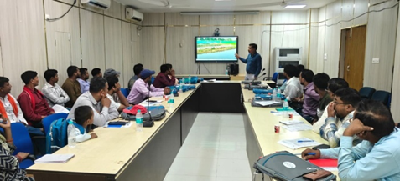
The training also incorporated interactive classroom discussions, field-based observations and experience sharing to connect scientific recommendations with actual farming conditions. Participants were encouraged to examine locally relevant challenges and identify feasible interventions for timely crop establishment, improved nutrient management and sustainable utilisation of land and water resources after flooding.
The concluding day's technical programme focused on horticulture-based integrated farming systems, Chaur fisheries resource management, fruit-based diversification, KVK-led technology dissemination and government schemes supporting post-flood agricultural development. These sessions highlighted the importance of integrating technological interventions with extension services and institutional support to facilitate wider adoption at the farmers' field level.
The three-day training strengthened the linkage between scientific research, field-level demonstrations and agricultural extension, highlighting practical pathways for restoring agricultural productivity and enhancing livelihood resilience in Bihar's flood-affected landscapes. Through this initiative, ICAR-MGIFRI reaffirmed its commitment to developing and disseminating climate-resilient, resource-efficient and integrated farming technologies for sustainable agricultural development in Diara and Chaur ecosystems.
(Source: ICAR–Mahatma Gandhi Integrated Farming Research Institute, Motihari, Bihar)





फेसबुक पर लाइक करें
यूट्यूब पर सदस्यता लें
X पर फॉलो करना X
इंस्टाग्राम पर लाइक करें