

French bean is a short-duration, high-value vegetable crop with significant potential to enhance farm productivity and income in the North Eastern Hill Region. Its tender pods are consumed as a vegetable, while mature seeds are used as dal, offering diverse food and market opportunities. The crop thrives in moderate climatic conditions and well-drained loamy soils with a pH of 6.0–7.0. Suitable bush varieties include Arka Komal, Contender and Selection-9, while Naga Local, Meghalaya Local and Manipuri are popular pole types. With a crop duration of approximately 75–90 days, French bean fits well into multiple cropping systems.
Timely sowing and scientific crop management are essential for successful cultivation. For green pod production, sowing is recommended during February–March in lowland areas and August to early September in uplands. Seed requirements range from 50–60 kg/ha for bush types and 25–30 kg/ha for pole types. Pole varieties require staking, while timely weeding, hoeing, thinning and earthing up support healthy crop growth. In rainfed uplands, irrigation may be provided during prolonged dry spells.
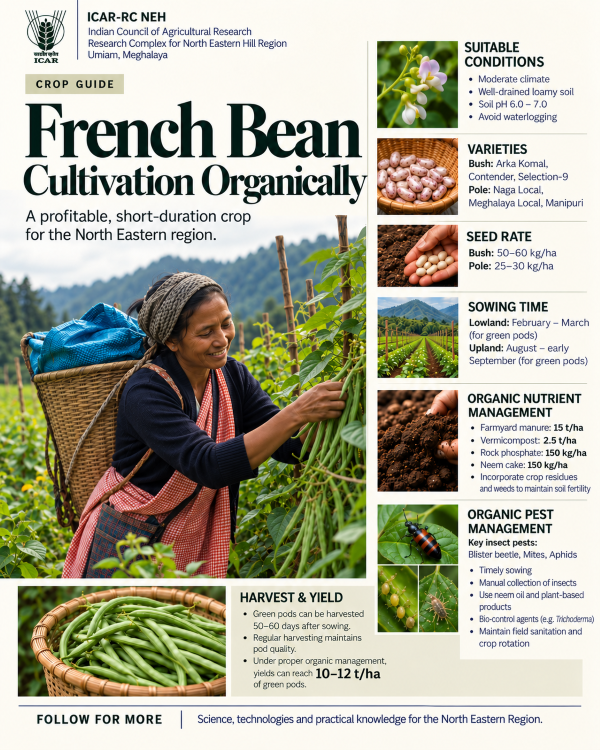
Organic nutrient management and eco-friendly crop protection help sustain soil health and productivity. Farmyard manure, vermicompost, rock phosphate and neem cake support nutrient supply, while crop residue incorporation improves soil fertility. Healthy seeds, crop rotation, field sanitation and biocontrol agents such as Trichoderma help manage diseases; neem oil and plant-based products can support insect pest management. Green pods can be harvested from around 50–60 days after sowing, with regular picking helping maintain quality.
Under proper organic management, the crop can yield 10–15 tonnes of green pods per hectare, making it a promising option for sustainable agriculture, diversified farming and enhanced farmer income in the region.
(Source: Division of System Research and Engineering, ICAR Research Complex for North Eastern Hill Region, Umiam, Meghalaya)





फेसबुक पर लाइक करें
यूट्यूब पर सदस्यता लें
X पर फॉलो करना X
इंस्टाग्राम पर लाइक करें