

As changing climatic conditions continue to challenge rainfed agriculture across the country, the ICAR–Indian Institute of Millets Research, Hyderabad, Global Centre of Excellence on Millets (Shree Anna) has taken a proactive step towards building resilient farming systems by introducing improved millet technologies among farmers of Parasurampura village in Chitradurga district, Karnataka. Under the Khet Bachao Abhiyan, ICAR-IIMR scientists conducted field demonstrations, distributed quality millet seeds, and directly engaged with farmers to promote sustainable agricultural practices that enhance productivity while conserving soil and natural resources.
Chitradurga district is known for its semi-arid climate, characterized by low and erratic rainfall, recurring dry spells, and moisture stress conditions that often affect crop productivity. To address these challenges, ICAR-IIMR introduced improved millet cultivation technologies that are naturally suited to such environments. Millets possess the unique ability to thrive under limited water availability and adverse climatic conditions, making them an ideal crop for strengthening the sustainability and resilience of farming systems in the region.
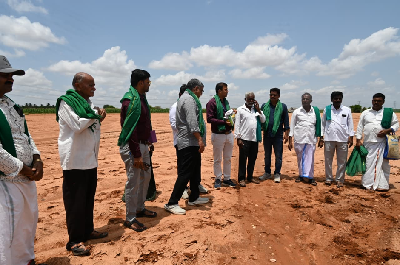
Through the active coordination of Kusumagiri Farmer Producer Organization (FPO), Anantapur, Andhra Pradesh, ICAR-IIMR reached 350 farmers with supply of three tonnes of quality millet seed and established demonstration plots to showcase improved millet production practices. The demonstrations enabled farmers to witness firsthand the performance and adaptability of millet crops under local field conditions and understand their potential as a profitable and climate-resilient alternative.
The scientists provided comprehensive technical guidance on improved crop establishment, balanced nutrient management, moisture conservation techniques, integrated crop management, and post-harvest practices. Particular emphasis was placed on soil stewardship and sustainable land-use practices that help improve soil organic matter, enhance water-holding capacity, reduce soil degradation, and support long-term farm productivity. Farmers were encouraged to adopt scientific nutrient management practices that not only improve crop performance but also contribute to the preservation of soil resources for future generations.
The initiative is expected to generate far-reaching benefits for farming communities by reducing vulnerability to climatic fluctuations, improving yield stability, lowering input-related risks, and promoting diversified farming systems. Adoption of millet-based agriculture can strengthen household nutritional security, create new livelihood opportunities, and improve farm profitability through access to emerging millet markets and value-added enterprises.
During the interaction, ICAR-IIMR scientists shared practical approaches for enhancing farm productivity through millet-centred cropping systems. Farmers were introduced to suitable intercropping models involving millets and legumes such as pigeonpea, cowpea, and greengram in scientifically recommended row proportions. These systems were demonstrated as effective strategies for maximizing land productivity, improving resource-use efficiency, enriching soil fertility through biological nitrogen fixation, and generating additional income streams. The sessions also covered moisture management, crop diversification, and sustainable farming approaches tailored to the needs of rainfed agriculture.
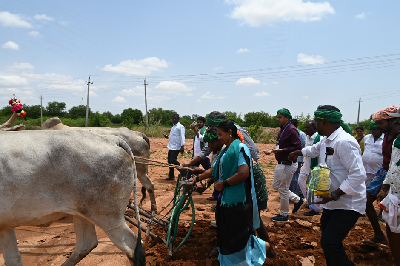
The farmers actively participated in the programme, sharing their experiences and gaining first-hand exposure to research-backed technologies and best practices. They expressed appreciation for the opportunity to learn directly from experts and observed that the demonstrations provided practical solutions to challenges commonly faced under rainfed farming conditions. The knowledge gained through the programme is expected to support informed decision-making, encourage wider millet adoption, and strengthen the resilience of farming systems across the region.
Through this intervention, ICAR-IIMR has once again demonstrated its leadership in advancing millet-based agricultural transformation by connecting scientific innovation with field-level action. The programme marks a significant step towards building climate-resilient farming communities, conserving natural resources, protecting soil health, and ensuring sustainable livelihoods for farmers in vulnerable agro-ecological regions.
(Source: ICAR–Indian Institute of Millets Research, Hyderabad)





फेसबुक पर लाइक करें
यूट्यूब पर सदस्यता लें
X पर फॉलो करना X
इंस्टाग्राम पर लाइक करें