

26 May 2026, Kota
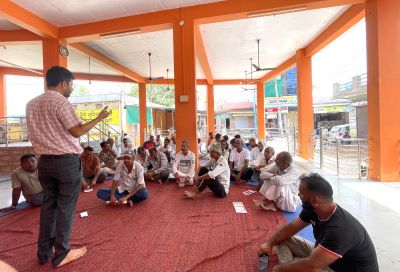
ICAR–Indian Institute of Soil and Water Conservation, Research Centre, Kota organized an awareness programme on ‘Improvement of Soil Health and Balanced Crop Nutrition’ at Kishanpura Takia village, Kota district, Rajasthan, today under the Balanced Use of Fertilizers Campaign of the Government of India. Major theme of the meeting was Soil Health Card Action Plan: Test Based Nutrient Management.
The major objective of the programme was to create awareness among farmers about sustainable nutrient management practices for maintaining soil health and balanced crop nutrition. During the programme, a technical lecture was delivered on the subject to improve nutrient availability, enhance the efficiency of applied inputs, and reduce dependence on chemical fertilizers for crop nutrition. Farmers were informed about the natural farming practices.
The farmers of Kishanpura Takia village were sensitized about the importance of adopting an Integrated Nutrient Management (INM) approach, combining chemical fertilizers with organic and biological sources of nutrients for maintaining long-term soil fertility and sustaining crop yields.
Farmers were advised to incorporate various organic nutrient sources such as farmyard manure (FYM), vermicompost, green manure, farm organic manure (FOM), brown manuring, and crop residues into their farming systems to improve soil organic carbon content, soil structure, and nutrient availability.
Special emphasis was laid on the scientific management of crop residues. Farmers were advised to incorporate crop residues into the soil immediately after harvesting using a mould board (MB) plough, which helps recycle nutrients, improve soil organic matter, and overcome the problem of residue accumulation in fields. The practice was highlighted as an effective strategy for improving soil health, enhancing nutrient recycling, and promoting environmentally sustainable agriculture.
The programme concluded with an interactive discussion session during which farmers shared their experiences and sought guidance on soil fertility management and balanced fertilizer use. The participants appreciated the practical recommendations provided and expressed keen interest in adopting the suggested practices for improving soil health and crop productivity.
The programme witnessed active participation of 40 farmers.
(Source: ICAR- Indian Institute of Soil & Water Conservation (IISWC), Research Centre, Udhagamandalam, Tamil Nadu)





फेसबुक पर लाइक करें
यूट्यूब पर सदस्यता लें
X पर फॉलो करना X
इंस्टाग्राम पर लाइक करें