

21 April 2026, New Delhi
In a major step towards sustainable urban development, ICAR-Indian Agricultural Research Institute, New Delhi, and Delhi Metro Rail Corporation (DMRC) have signed a landmark Memorandum of Understanding (MoU) to develop India’s first scientifically designed green belt along the Delhi Metro Yellow Line. The agreement was formalized in the presence of Dr Ch. Srinivas Rao, Director, ICAR-IARI; Dr Viswanathan Chinnusamy, Joint Director (Research); and Shri Manuj Singhal, Director, DMRC, along with other senior officials. The initiative aims to transform the national capital into a greener and cleaner city through science-driven interventions.
Under this collaboration, ICAR-IARI will provide advanced scientific advisory and technical expertise to develop a resilient urban green corridor along a 1.5 km stretch between Adarsh Nagar and Jahangirpuri metro stations. The project aims to convert a challenging concrete median characterized by deep shade, vehicular emissions, and extreme heat into a vibrant, climate-resilient, and pollution-mitigating green ecosystem.
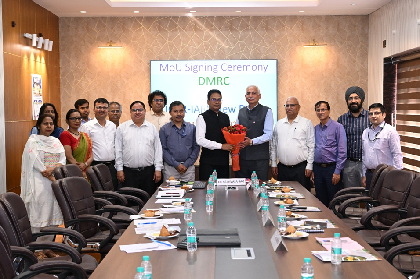
Highlighting the importance of the initiative, Dr. Ch. Srinivas Rao, Director ICAR-IARI, described the MoU as a transformative effort to extend agricultural science beyond traditional farming into urban infrastructure. He emphasized that such initiatives would significantly improve air quality and enhance urban livability. He emphasised that the project reflects the effective integration of scientific research with real-world urban challenges, strengthening ICAR-IARI’s role in delivering scalable and impact-oriented solutions for sustainable cities.
Echoing this vision, Shri Singhal stated that the initiative represents a forward-looking approach to metro infrastructure development and expressed confidence that, upon successful implementation, the model can be expanded across the Delhi Metro network, potentially creating one of Asia’s longest scientifically managed green metro corridors.
The one-year pilot project, with a budget of ₹20.29 lakh (including GST), will be executed through scientifically structured phases including site assessment, biophilic design, and selection of pollution-tolerant plant species using the Air Pollution Tolerance Index (APTI). It will also incorporate innovative approaches such as biochar-based soil enhancement, mycorrhizal technology, and IoT-enabled smart irrigation systems, supported by continuous monitoring and evaluation. Aligned with national priorities on clean air, climate resilience, and sustainable urban development, this initiative positions ICAR-IARI and DMRC at the forefront of evidence-based urban greening.
(Source: ICAR-Indian Agricultural Research Institute, New Delhi)





फेसबुक पर लाइक करें
यूट्यूब पर सदस्यता लें
X पर फॉलो करना X
इंस्टाग्राम पर लाइक करें