

Mrs. Madhu Patel, a resident of Gajendra Bigha village in the Hilsa block of Nalanda district, Bihar, stands today as a remarkable symbol of resilience, innovation, and rural entrepreneurship. Until a few years ago, her family’s livelihood depended solely on medicinal plant cultivation practiced by her husband on a small landholding of 1–5 acres. However, the income generated from this activity was inadequate to meet the family’s basic livelihood and nutritional needs. The situation worsened dramatically after the devastating floods of 2008, which severely disrupted their farming system and pushed the family into financial distress.
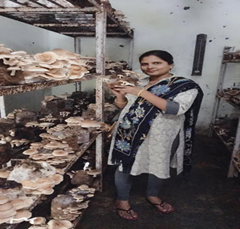
Determined to overcome these challenges, Mrs. Patel ventured into self-employment as a means of securing a sustainable livelihood. With technical guidance from scientists at Krishi Vigyan Kendra, Nalanda, she adopted mushroom cultivation as an alternative income-generating activity. She began modestly with just 60 mushroom bags, earning a small seasonal income. Simultaneously, she enhanced her skills through training in mushroom value addition. Following advanced capacity-building programmes conducted by KVK, she started preparing a range of mushroom-based food products and recipes, which gradually gained popularity in nearby villages.
Under the banner of the Ujjwal Bihar Mushroom Farmer Interest Group, Gajendra Bigha (Hilsa), Mrs. Patel and her group members began cultivating milky white, button, and oyster mushrooms. In addition, several value-added products such as mushroom pickle, namkeen, sev, laddoos, and mathri were prepared and marketed, adding new dimensions to income generation and employment.
In the initial phase, the absence of a mushroom spawn laboratory in Nalanda district posed a major challenge, forcing Mrs. Patel to procure spawn from distant locations such as Delhi and Ranchi at high costs. Recognizing this constraint as an opportunity, she resolved to establish her own spawn production unit. She underwent specialized training at KVK Nalanda and the Directorate of Mushroom Research, Solan (Himachal Pradesh). With technical support from KVK and financial assistance under the National Horticulture Mission, she successfully established the Buddha Mushroom Spawn Laboratory at Rajgir. Today, she sells 50–60 kg of spawn daily at ₹80 per kg, with each 1-kg packet capable of producing 10–15 kg of mushrooms.
From an initial production of just 10 kg of spawn, Mrs. Patel has scaled up operations to nearly 700 kg, supplying quality spawn across Bihar, Jharkhand, eastern Uttar Pradesh, and Chhattisgarh. She has further expanded her market reach by leveraging online platforms such as Amazon. The easy availability of high-quality spawn at affordable prices has encouraged widespread adoption of mushroom cultivation, particularly among rural women. Through Self-Help Groups (SHGs), Mrs. Patel has empowered nearly 3,000 women by linking them to mushroom-based enterprises. Recognizing the nutritional value of mushrooms, they have also been incorporated into the weekly Anganwadi menu in Nalanda district. Market linkages have been further strengthened through collaboration between the district administration and the Sudha Milk Cooperative, ensuring assured marketing channels for mushroom produce.
KVK interventions played a pivotal role in enhancing the economic viability of both mushroom cultivation and spawn production enterprises.
In mushroom cultivation, the cost of production declined from ₹8,000 to ₹5,000 per quintal, while income per quintal increased from ₹10,000 to ₹11,000. Total production rose from 6.40 to 11.0 quintals, resulting in an increase in net income from ₹56,000 to ₹1,16,000 and generating employment for two persons for 120 days. In mushroom spawn production, production costs reduced from ₹4,200 to ₹3,150 per quintal, while total output increased dramatically from 10 to 500 quintals. Consequently, net income surged from ₹58,000 to ₹40,03,500, with employment expanding from two persons for 60 days to four persons for 250 days.
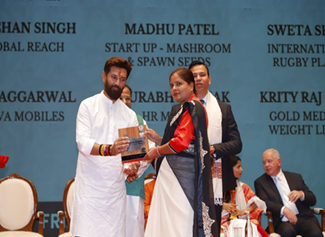
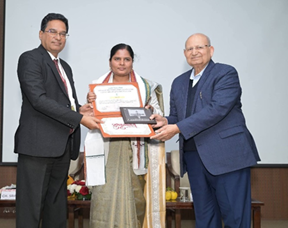
Mrs. Patel’s achievements have earned her widespread recognition. She has served as Chairperson of the Mushroom Growers’ Association of Nalanda and received the Innovative Farmer Award from Bihar Agricultural University, Sabour. Her enterprise has attracted visits from district and state authorities, including the Chief Minister of Bihar, Shri Nitish Kumar. Most recently, she was conferred the prestigious ICAR–IARI Innovative Farmer Award at the Pusa Krishi Vigyan Mela held during 22–24 February 2025.
Overall, Mrs. Madhu Patel’s journey exemplifies the transformative impact of KVK-led entrepreneurship development in empowering rural women, fostering innovation, and strengthening sustainable livelihoods in rural India.
(Source: KVK Nalanda, ICAR-Agricultural Technology Application Research Institute, Zone-IV Patna)





फेसबुक पर लाइक करें
यूट्यूब पर सदस्यता लें
X पर फॉलो करना X
इंस्टाग्राम पर लाइक करें