

With increasing awareness about healthy lifestyles and balanced diets, particularly among urban consumers, the demand for functional foods rich in essential nutrients has grown significantly. Edible-podded peas have emerged as a preferred vegetable legume owing to their nutritional richness and versatility in consumption. These peas provide appreciable quantities of protein (2.7–3.1 g per 100 g fresh weight), dietary fibre (2.5–3.0 g per 100 g fresh edible pods), and bioactive compounds such as phenolics and chlorophyll. When consumed fresh or raw, edible-podded peas serve as a valuable source of antioxidants and natural pigments, contributing to multiple health benefits. Consequently, their demand has increased rapidly, especially in metropolitan regions with strong linkages to supermarkets, institutional buyers, and the hospitality sector.
Responding to this growing market demand, the ICAR–Indian Institute of Vegetable Research, Varanasi, has developed Kashi Tripti, a high-yielding edible-podded pea variety belonging to the mid-maturity group. Notably, Kashi Tripti represents the first edible-podded pea variety developed from Uttar Pradesh, marking a significant milestone in vegetable crop improvement in the region.
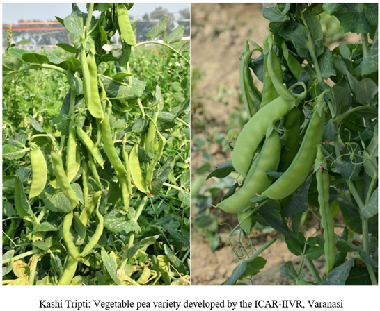
Kashi Tripti exhibits desirable agronomic traits suitable for commercial cultivation. The variety attains 50 per cent flowering within 50–56 days after sowing, and the first picking of tender edible pods becomes ready within 80–85 days. Plants produce 12–15 crisp, attractive green pods per plant, completely free from parchment layers, ensuring excellent tenderness and eating quality. The average pod weight ranges from 7.1 to 8.0 g, contributing to uniformity and market appeal. With a high yield potential of 95–100 quintals per hectare harvested over 3–4 pickings, Kashi Tripti offers substantial economic returns to farmers.
In addition to its yield advantage, the variety stands out for its superior nutritional and quality attributes. It contains a high protein content of 21.9 per cent on a dry weight basis and exhibits desirable sweetness, reflected in total soluble solids (TSS) of 11°Brix in whole pods and 13.9°Brix in fresh green seeds. Kashi Tripti is also rich in health-promoting bioactive compounds, including ascorbic acid (33.4 mg per 100 g fresh weight), total phenolics (31 mg gallic acid equivalents per 100 g fresh weight), and flavonoids (16.37 mg catechin equivalents per 100 g fresh weight), enhancing its nutritional value and consumer preference.
From a crop protection perspective, Kashi Tripti possesses resistance to powdery mildew, a major disease of pea, thereby contributing to improved crop stability, reduced yield losses, and lower dependence on chemical plant protection measures. Owing to its consistent performance, superior quality, and suitability for market-oriented production, the variety was recommended for commercial cultivation in Uttar Pradesh by the State Variety Release Committee (SVRC) in 2024.
Overall, Kashi Tripti represents a successful example of ICAR-led varietal development aligned with evolving consumer preferences, offering farmers a high-yielding, nutritious, and market-responsive edible-podded pea variety while strengthening vegetable production systems in the region.
(Source: ICAR- Indian Institute of Vegetable Research, Varanasi)





फेसबुक पर लाइक करें
यूट्यूब पर सदस्यता लें
X पर फॉलो करना X
इंस्टाग्राम पर लाइक करें