

How a tribal farm woman transformed 2.2 acres into a diversified livelihood enterprise through farming, entrepreneurship and traditional knowledge
In Rammohon Pujari Para village of Belbari Block, West Tripura district, 47-year-old Mrs. Arati Debbarma has turned a modest 2.2-acre farm into a diversified livelihood enterprise, combining agriculture, livestock, fisheries, mushroom cultivation and traditional tribal crafts.
A widow with more than two decades of farming experience, Mrs. Debbarma began with a small kitchen garden. Over the years, her determination to create a more secure livelihood led her to gradually diversify her farm. Today, her integrated farming system includes seasonal vegetables, oyster mushroom cultivation, piggery, fishery, medicinal and aromatic plants, along with traditional weaving and tailoring.
Her journey reflects how a small farm, when supported by knowledge, innovation and enterprise diversification, can become a source of multiple and sustained livelihood opportunities.
From a Kitchen Garden to an Integrated Farm
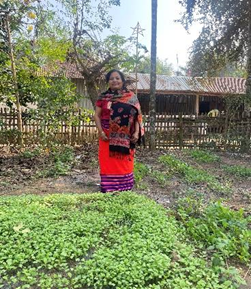
Mrs. Debbarma’s farming journey began on a small scale, but she gradually expanded the range of activities on her farm. Seasonal vegetables such as mustard, peas, potato, radish, okra, French bean, pumpkin, cabbage and cauliflower form an important part of her production system.
A fish pond, along with medicinal and aromatic plants, adds further diversity to the farm. The different components complement one another, enabling her to make productive use of available land and resources while creating income opportunities at different times of the year.
Among these enterprises, oyster mushroom cultivation has emerged as an important source of household income.
Mushrooms: A New Source of Income
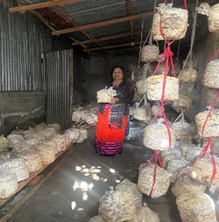
Using locally available materials, Mrs. Debbarma undertakes three mushroom production cycles annually and markets fresh oyster mushrooms directly to local consumers.
The enterprise contributes approximately ₹3–4 lakh annually to her household income, based on her reported farm-level returns. Beyond its economic contribution, mushroom cultivation has enabled her to utilise limited space and locally available resources for an enterprise that can be managed alongside other farm activities.
Piggery Strengthens the Livelihood Portfolio
Piggery is another important pillar of Mrs. Debbarma’s integrated farming system. With more than two decades of experience in pig rearing, she currently maintains four breeding pigs and markets piglets through local channels.
The piggery enterprise contributes approximately ₹4.8 lakh annually to her household income, based on her reported annual returns.
Together, mushroom cultivation and piggery have created significant additional income streams, while crop production, fishery and other farm activities provide further diversification.
Farming Meets Heritage
Mrs. Debbarma’s enterprise extends beyond agriculture.
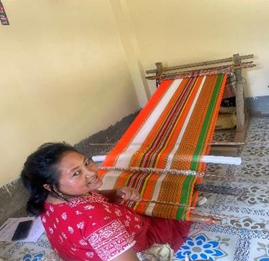
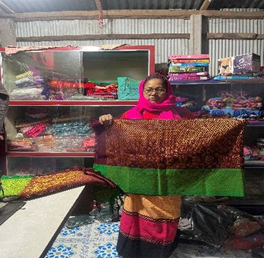
She has revived traditional tribal weaving, producing the traditional Rignai, and has established a tailoring unit and a small shop for traditional garments. These activities provide an additional source of livelihood while contributing to the preservation and promotion of the cultural heritage of her community.
The combination of farming and traditional craftsmanship has enabled her to build a livelihood model that is rooted not only in agricultural production but also in local skills and cultural knowledge.
Knowledge as the Foundation of Transformation
The transformation of Mrs. Debbarma’s farm has been supported by ICAR–Krishi Vigyan Kendra (KVK), West Tripura, through technical guidance, capacity building and critical inputs.
The support has covered diverse aspects of her enterprise, including Integrated Farming System, mushroom cultivation, nutri-garden management, organic and natural farming, livestock management and entrepreneurship.
The technical interventions have helped her strengthen existing activities while taking up new enterprises suited to her resources and local conditions.
From Beneficiary to Rural Role Model
Mrs. Debbarma’s journey is now extending beyond her own farm. She actively shares her experiences with fellow rural women and participates in Self-Help Groups (SHGs), creating opportunities for knowledge exchange and encouraging other women to explore livelihood and enterprise opportunities.
Her experience demonstrates the potential of women-led farm diversification to generate income while strengthening local skills and community-level entrepreneurship.
A Vision Beyond the Farm
With an established diversified enterprise in place, Mrs. Debbarma is now looking towards the next stage of her journey. She aspires to promote eco-tourism linked with integrated farming and tribal cultural heritage, with the aim of creating additional livelihood opportunities for women and rural youth.
Her vision seeks to bring together the different strengths of her enterprise—agriculture, livestock, local food production and tribal crafts—into a broader rural experience rooted in the community’s natural and cultural heritage.
A Story of Resilience and Possibility
From a small kitchen garden to a 2.2-acre integrated farming enterprise, Mrs. Arati Debbarma’s journey reflects the possibilities that emerge when determination is combined with scientific knowledge, local resources and enterprise diversification.
Her success demonstrates that livelihood transformation does not always require large landholdings or high investments. With the right technical support and a willingness to diversify, a small farm can become the foundation for multiple sources of income, employment and entrepreneurship.
For Mrs. Debbarma, farming has evolved from a means of sustenance into a platform for enterprise, empowerment and community leadership. Her journey stands as an encouraging example of how rural women can build resilient livelihoods while preserving the agricultural and cultural traditions that define their communities.





फेसबुक पर लाइक करें
यूट्यूब पर सदस्यता लें
X पर फॉलो करना X
इंस्टाग्राम पर लाइक करें