

From 3 acres in 2020 to a diversified 12-acre natural farm, Shri Mantuk Phom of Longleng is demonstrating how farmer innovation, local resources and sustained technical guidance can build resilient agricultural livelihoods
In the hills of Longleng district, Nagaland, where farming is closely intertwined with the rhythms of nature, Shri Mantuk Phom, a progressive farmer from Apoiji Village, Tamlu Block, has built a remarkable agricultural enterprise rooted in natural farming.
What began in 2020 with just 3 acres has now grown into a 12-acre diversified natural farming system, integrating tea, rice, banana, vegetables, livestock and fisheries. With a reported annual gross farm return of ₹14.25 lakh, Shri Phom’s journey demonstrates how perseverance, farmer-led innovation and technical support can transform a farming enterprise while making better use of locally available resources.
From an Experiment to a Way of Farming
Shri Phom began his transition to natural farming after receiving training from ICAR–Krishi Vigyan Kendra (KVK), Longleng. The initial transition, however, was not without challenges. Following the discontinuation of chemical inputs, he experienced a decline in crop yields.
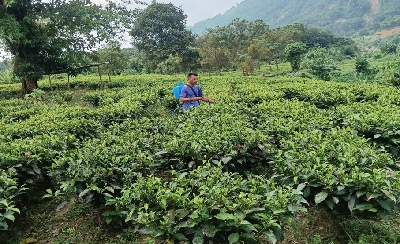
Instead of abandoning the approach, he continued to learn, experiment and refine his practices with technical guidance from the KVK. Over time, his confidence in natural farming grew, and he gradually expanded the system across his farm. Today, the entire 12-acre holding is managed under natural farming practices, supported by crop diversification, mixed cropping, mulching, livestock integration and on-farm resource recycling.
His farm has thus evolved from a conventional production unit into a diversified and interconnected farming system, where one enterprise supports another and farm resources are put to repeated use.
Turning Farm Resources into Farm Strength
A key feature of Shri Phom’s farming system is his emphasis on preparing and using natural inputs from resources available on the farm.
He prepares and uses Ghanajeevamrit, Jeevamrit, Beejamrit, Neemastra, Agniastra and botanical extracts for crop production and protection. Ghanajeevamrit is applied at approximately 400 kg per acre, while Jeevamrit is applied through irrigation water and foliar spraying at around 15-day intervals. Beejamrit is used for seed treatment, with approximately 20 litres used to treat up to 100 kg of seed.
He also practises Pre-Monsoon Dry Sowing (PMDS)/Navadanya, comprising 18–20 crop species, as a summer relay crop.
Adding a distinct local dimension to his natural farming system is ‘Mantukastra’, a botanical preparation developed by Shri Phom and popularly known by this name among the Phom Tribe. The practice reflects how farmers can adapt and develop locally relevant solutions by combining traditional knowledge with technical guidance.
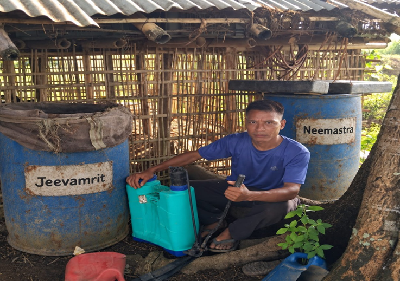
Building Soil Health from Within
For Shri Phom, natural farming is not limited to avoiding external chemical inputs. It is also about strengthening the farm’s internal resource cycle.
Crop residues are used as cattle feed and mulch, while livestock resources contribute to the preparation of natural farming inputs. This interconnected system reduces dependence on external resources while returning organic matter to the farm.
The changes have also been reflected in soil observations. More than 50 analysed soil samples were reportedly found to be rich in organic carbon after two years of natural farming, with organic carbon exceeding 1.25% in some fields.
Compared with May 2024, available phosphorus increased by 89% in May 2025, 32% in October 2025 and 179% in May 2026 in the respective samples. Available potassium and selected micronutrients also showed reported increases.
Shri Phom has additionally observed better crop performance during drought conditions and reduced dependence on external agricultural inputs. The diversification of his farm has helped generate income from different enterprises across the year, providing greater continuity to the farm-based livelihood.
Diversification that Delivers
The strength of Shri Phom’s farm lies in its diversity.
Of the 12 acres, tea occupies 6 acres, producing a reported 158 quintals of green leaf and generating a gross return of ₹7.90 lakh, calculated at an average price of ₹50 per kg.
Tea, however, is only one part of the enterprise. Rice, banana, king chilli, maize, ginger, turmeric and various vegetables, along with livestock and fisheries, contribute additional income and make the farm a year-round production system.
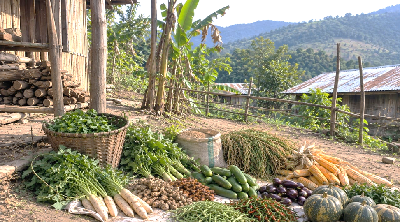
The listed enterprises together generate a reported total gross return of ₹14,24,850. Against an estimated cultivation and marketing cost of ₹3,15,000, the estimated net return stands at ₹11,09,850. The enterprise also provides employment to 10 workers.
Thus, diversification has not only expanded the range of crops and activities on the farm but has also created multiple sources of income and employment.
From Farmer to Community Resource Person
The transformation of Shri Phom’s farm has been supported by the sustained technical guidance of ICAR–KVK Longleng. Shri Shubhendu Kumar Behera, Subject Matter Specialist, under the guidance and support of Dr. Hari Charan Kalita, Senior Scientist and Head, ICAR–KVK Longleng, has played an important role in providing technical support to the farmer.
Shri Phom’s association with the KVK has included training programmes, field visits, Farmer Field Schools, training videos, KVK events and exposure visits. These interventions helped strengthen his understanding of natural input preparation, crop diversification, botanical crop protection and on-farm resource recycling.
His experience has now extended beyond his own farm.
As a Community Resource Person (CRP), Shri Phom has reportedly trained 211 farmers across Longleng district. Of these, 67 farmers from Setap, Ngetchongching, Namha, Bura Namsung and Pongching are practising natural farming.
His farm itself has become a practical learning platform where fellow farmers can observe natural farming practices in action. In this way, an individual farmer’s experiment is gradually becoming a source of knowledge and inspiration for the wider farming community.
A Model Rooted in Local Resources
Shri Mantuk Phom’s journey from 3 acres of natural farming in 2020 to a diversified 12-acre enterprise illustrates the possibilities that emerge when farmer initiative is supported by sustained technical guidance.
His experience shows that natural farming can extend beyond individual crop practices to encompass diversification, livestock integration, natural input preparation, resource recycling and farmer-to-farmer knowledge sharing. In the predominantly hilly and rainfed conditions of Longleng, these approaches offer valuable lessons in building resilient and resource-efficient agricultural livelihoods.
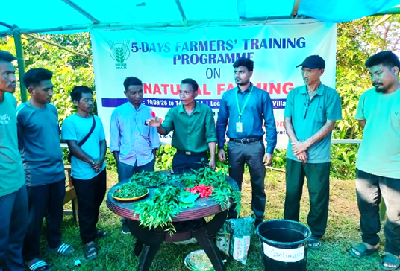
The reported improvements in soil health, crop resilience, farm income and employment further underline the potential of an integrated farming approach. At the same time, Shri Phom’s role as a Community Resource Person is helping take these experiences beyond his own farm and into neighbouring farming communities.
Looking ahead, small-scale tea processing, packaging, branding and value addition could create further opportunities to strengthen market access and enhance farm income.
From a modest beginning on three acres to a thriving 12-acre natural farming enterprise, Shri Phom’s story is ultimately a story of persistence, adaptation and faith in local resources—showing how a farmer, with the right knowledge and support, can turn a challenging transition into a pathway towards a more diversified and resilient livelihood.





फेसबुक पर लाइक करें
यूट्यूब पर सदस्यता लें
X पर फॉलो करना X
इंस्टाग्राम पर लाइक करें