

An Exposure cum Interaction Session under ADB-Funded Project “Building capacity for climate change adaptation in Smallholder Fish Farming”
3 September 2026, Goa
As part of the ADB-funded project “Building Capacity for Climate Change Adaptation in Smallholder Fish Farming” implemented by ICAR-Central Coastal Agricultural Research Institute, Goa, an exposure-cum-interaction session was organized at the Post Graduate Centre, Karnataka University, Karwar, today. The programme aimed to strengthen the technical capacity of small-scale fish farmers and promote climate-resilient and sustainable aquaculture practices. Particular emphasis was given to challenges faced by seabass (Lates calcarifer) cage culture farmers, including high water flow, seed availability, disease management, stocking density, feed management, harvesting and marketing.
The programme commenced with an inaugural technical session focusing on climate-resilient aquaculture, capacity building and strengthening farmer–scientist interactions. The session provided valuable technical and institutional inputs on sustainable fisheries management, improved aquaculture practices, species and technological diversification, and the adoption of integrated farming systems.
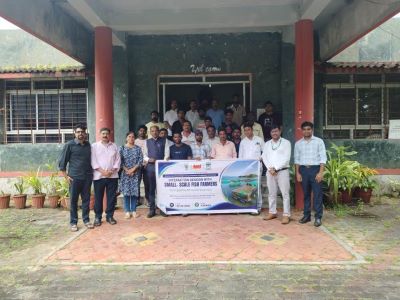
During the interactive discussion, participating farmers raised key concerns related to high water flow in cage culture, seed cost and availability, seabass marketing, crab farming and collective procurement. Technical guidance was provided on suitable measures to manage excessive water flow in cages, including the use of temporary shade-net barriers and appropriate pen arrangements.
The discussions also covered various approaches to crab farming, seabass polyculture, direct marketing of seabass to hotels, partial harvesting and grading, along with the formation of Fish Farmer Producer Organisations (FFPOs) and collective procurement of feed and seed. These interventions were highlighted as potential strategies for improving production efficiency, reducing input costs and strengthening market access.
The technical session enhanced farmers’ awareness of water-quality management, feed management, optimal stocking density, cage maintenance, seed acclimatisation, integrated aquaculture, value addition and market linkages. Emphasis was also placed on adopting sustainable aquaculture practices and promoting collective action through farmer producer organisations.
The interaction strengthened linkages among fish farmers, ICAR-CCARI, ICAR-CMFRI and Karnataka University, facilitating practical problem-solving, knowledge exchange and greater access to scientific and technical guidance. The participation of fish farmers and representatives from research, academic and development institutions contributed to the successful conduct of the interaction and provided a platform for identifying practical solutions to field-level aquaculture challenges.
(Source: ICAR-Central Coastal Agricultural Research Institute, Goa)





फेसबुक पर लाइक करें
यूट्यूब पर सदस्यता लें
X पर फॉलो करना X
इंस्टाग्राम पर लाइक करें