

Nestled in the foothills of the Himalayas, Domat village in the Kalsi Block of Dehradun district, Uttarakhand, has quietly emerged as an inspiring example of how indigenous knowledge, coupled with community innovation, can transform rural livelihoods.
The Kalsi Block, spread over nearly 270 sq. km, experiences a subtropical climate with hot summers, cold winters, and an average annual rainfall of about 1,500 mm. Its fertile loamy soils support the cultivation of cereals, vegetables, fruits, and livestock farming. Amid this diverse agricultural landscape, ginger has evolved into one of the most profitable cash crops, creating new opportunities for the farming community.
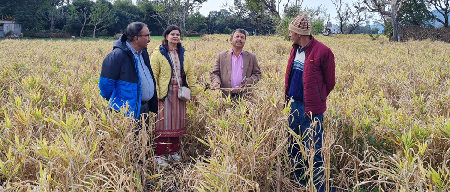
A Crop with Immense Potential
For generations, farmers in Domat have cultivated ginger, recognizing its high market demand for culinary, medicinal, and cosmetic uses. Besides offering attractive economic returns, ginger is a hardy crop well suited to the hilly terrain and contributes to sustainable agriculture by improving soil fertility, reducing erosion, and enhancing water retention through its deep root system.
The crop also plays an important role in the local healthcare system, where it is traditionally used to treat ailments such as nausea, colds, and inflammation. Furthermore, ginger cultivation generates substantial employment opportunities, particularly during harvesting and post-harvest processing.
However, the villagers understood that the real value of ginger lay not merely in cultivation but in scientific post-harvest processing, which significantly improves its marketability, shelf life, and economic value.
Preserving Tradition through Innovation
The farming community has preserved two remarkable indigenous processing techniques—Sukhjhol and Panjhol—that have become the hallmark of Domat village. These traditional methods produce high-quality dried ginger, locally known as "Gilti", which commands premium prices in the market.
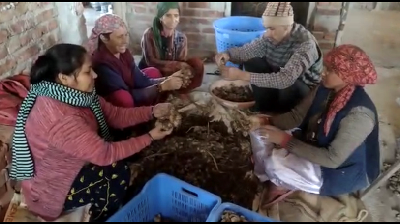
The processing begins with careful harvesting, cleaning, grading, and washing of freshly harvested rhizomes. Great care is taken during washing to avoid damage that may lead to decay or shrinkage. Farmers ensure that only healthy, mature rhizomes with bright yellow-brown skin are selected for processing.
Processing ginger offers multiple advantages. It improves digestibility, enhances the bioavailability of valuable compounds such as gingerols and shogaols, enriches flavour and aroma, and significantly extends shelf life, making storage and marketing easier while preserving the crop's nutritional integrity.
Sukhjhol: A Labour-Saving Indigenous Innovation
Among the two methods, the Sukhjhol technique is considered more efficient by the villagers because it eliminates the need for peeling before drying, thereby reducing labour requirements.
After grading and washing, the ginger is shade-dried for a day before being partially dried under natural sunlight. The semi-dried rhizomes are then processed using an innovative rotary drying machine designed and fabricated by the villagers themselves.
The machine, available in both manual and 2 HP motor-operated versions, is a remarkable example of grassroots engineering. Capable of drying nearly one quintal of ginger per hour, it substantially reduces labour and processing time. The horizontal rotating drum, fitted with perforations, removes excess moisture while gently rotating the rhizomes until they are completely dried.
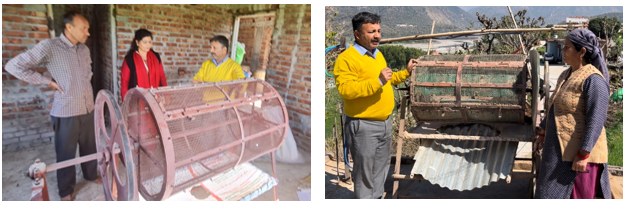
An added advantage of this process is that the peeled outer layer separated during rotation is collected and later utilized in the preparation of ginger spice powder, ensuring minimal wastage.
Following machine drying, the ginger undergoes further sun drying until it reaches the desired quality. The final dried product, locally known as "Gilti," is highly valued in the spice market.
Panjhol: Preserving Quality through Traditional Practice
The Panjhol method follows similar steps of washing, sorting, grading, and drying but differs primarily in the manual peeling of the rhizomes before drying.
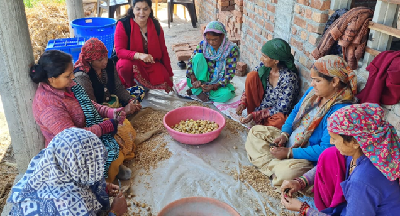
The peeling is carried out carefully by experienced farm women, who gently scrape only the outer skin using sharp knives without damaging the essential oil-rich tissues beneath. This traditional skill helps retain the flavour, aroma, and medicinal properties of the dried ginger.
The peeled rhizomes are subsequently dried using the same indigenous rotary drying machine before undergoing final sun drying. The result is another premium-quality dried ginger product that enjoys strong market demand.
Importantly, both Panjhol and Sukhjhol are low-cost, energy-efficient, and environmentally sustainable processing techniques that rely primarily on locally available resources and indigenous knowledge.
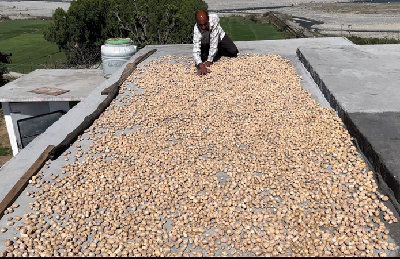
From Indigenous Knowledge to Economic Prosperity
Recognizing the economic significance of these traditional processing methods, Krishi Vigyan Kendra conducted a study to assess their impact on the livelihoods of Domat's farming community.
The findings were remarkable.
Out of nearly 100 families residing in the village, around 80 families have adopted ginger cultivation and processing as their primary cash-generating enterprise. Both Panjhol and Sukhjhol techniques are widely practiced to produce premium-quality "Gilti."
Collectively, the village produces nearly 25,000 kg of dried ginger annually. The finest grade is sold at ₹3,000–₹5,000 per kg, while second and third-grade produce fetches ₹1,500–₹2,000 per kg in nearby mandis.
Together, these traditional enterprises generate an estimated annual income of nearly ₹8 crore from ginger alone, transforming the local economy and significantly improving household incomes.
The Way Forward
The remarkable success of Domat village demonstrates how indigenous technologies, when effectively preserved and promoted, can become powerful instruments of rural prosperity.
To further strengthen this success, the formation of a Farmer Producer Organisation (FPO) or cooperative society could enable farmers to collectively store processed ginger in scientific warehouses, improve bargaining power, negotiate better prices, develop their own brands, and explore domestic as well as international markets.
Scaling up value addition and branding would not only enhance farmers' incomes but also create additional employment opportunities in processing, packaging, storage, marketing, and logistics.
Today, Domat stands as a shining example of how traditional wisdom, community-led innovation, and value addition can transform a single crop into a sustainable engine of rural development. The indigenous Panjhol and Sukhjhol processing techniques have not only preserved a rich cultural heritage but have also empowered farming families, strengthened the local economy, and established a replicable model for sustainable agricultural entrepreneurship in the Himalayan region.





फेसबुक पर लाइक करें
यूट्यूब पर सदस्यता लें
X पर फॉलो करना X
इंस्टाग्राम पर लाइक करें