

As part of the ongoing Khet Bachao Abhiyan, a multidisciplinary team of scientists from ICAR–Directorate of Floricultural Research, Pune, conducted an awareness and demonstration programme on Biointensive Protected Cultivation of Roses with Good and Sustainable Agricultural Practices at Jathegaon Village, Shikrapur, Pune district.
Jathegaon village comprises nearly 20 protected cultivation units of roses, each covering an area of approximately 1 to 2 acres. During the visit, the team interacted with rose growers and assessed the prevailing cultivation practices in polyhouse units. A total of one awareness programme and two on-site demonstrations were conducted to sensitise farmers on sustainable rose cultivation under protected conditions.
The scientists emphasised the judicious use of chemical fertilisers through fertigation and advised farmers to increase the application frequency of biofertilisers, microbial consortia, and biostimulants from once to twice a week for improved soil and plant health. Guidance was also provided on Integrated Plant Health Management (IPHM) strategies after visiting newly established rose polyhouses, with special focus on preventing pests and diseases such as crown gall and thrips.
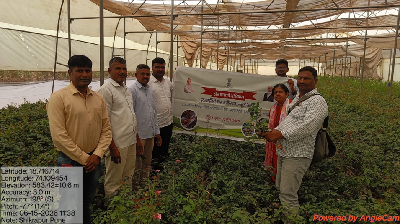
The beneficial role of microbial consortia in improving soil fertility and plant vigour was explained to the farmers. Details of suitable microbial consortia available at ICAR institutes, along with relevant contact information, were shared to facilitate adoption.
An on-site demonstration on the installation and placement of blue sticky traps for managing insect pests under polyhouse conditions was conducted at the polyhouse of Mr. Revanath. Farmers were encouraged to install both yellow and blue sticky traps in their respective units for effective pest monitoring and management.
A live demonstration of Good Agricultural Practices (GAPs), including clean cultivation and proper polyhouse maintenance, was conducted by visiting different protected cultivation units and comparing cultivation practices and produce quality. The scientists highlighted how scientific management practices contribute to better productivity and economic returns.
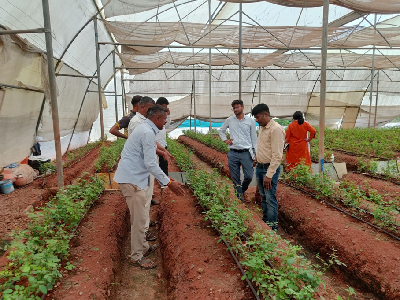
Further, the prospects of integrated farming systems involving poultry and the use of poultry waste as organic manure in polyhouses were demonstrated at the farm of Mr. Shrikant Wakhchore. The positive impact of biostimulants on the growth and productivity of roses was also demonstrated at his polyhouse.
Scientists encouraged farmers to form Farmer Producer Organisations (FPOs) for collective growth and better market opportunities. Various government schemes supporting protected cultivation and farming activities were also explained. Farmers acknowledged the support extended by the National Horticulture Board (NHB) in establishing polyhouse infrastructure.
(Source: ICAR–Directorate of Floricultural Research, Pune)





फेसबुक पर लाइक करें
यूट्यूब पर सदस्यता लें
X पर फॉलो करना X
इंस्टाग्राम पर लाइक करें