

ICAR-National Research Institute for Integrated Pest Management, New Delhi in collaboration with Krishi Vigyan Kendra- II, Sitapur under the Scheduled Caste Sub-Plan, organized a technical & scientific empowerment programme for SC farmers in adopted villages Amarapur (Parsendi block) and Kamuwa (Biswan block) for the development of ICT-Enabled Smart Village, Smarter Future & implementation of Integrate Pest Management practices through ICT-Based Pest Surveillance and Advisory Services.
The focus is to improve the income and sustainability of SC farmers, a focused intervention through the adoption of ICT based IPM approach.
Decision-making should be data-driven, leveraging ICT tools like mobile apps, GIS mapping, Drones and predictive models to guide interventions with precision. The National Pest Surveillance System offers a modern, technology-driven alternative to traditional pest management methods.
As a new initiative two ICT-enabled kiosks were inaugurated in the adopted villages by Dr R. Thangavellu, Director, ICAR-NRIIPM to emphasize the adoption of modern technologies for sustainable Pest Management. The kiosks also facilitate the dissemination of multimedia training materials, expert advisories and mobile-based alerts, enhancing farmer’s awareness and decision-making capacity.
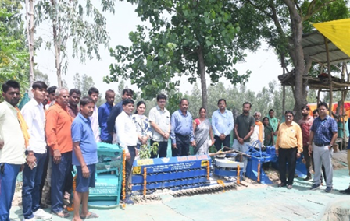
The ICT-enabled kiosks established in villages can significantly support the implementation of Integrated Pest Management (IPM) by serving as village-level information and advisory centers. IT can provide farmers with timely pest and disease surveillance updates, weather-based advisories and crop-specific IPM recommendations.
Farmers can access information on pest identification, economic threshold levels (ETLs), biological control agents, cultural practices and need-based pesticide application, thereby reducing indiscriminate pesticide use. In addition, they enable rapid communication between farmers, KVK scientists and ICAR-NRIIPM experts, promoting early detection of pest outbreaks and timely adoption of appropriate IPM interventions, ultimately leading to improved crop productivity, reduced production costs and environmentally sustainable agriculture.
The modern agricultural machinery and equipment including solar dryers, multi-crop threshers, reaper binders, agricultural kiosks and sprayers were distributed to farmers based on local needs and farming conditions.
During the programme, the NPSS app and web portal were demonstrated, and participants were informed about the various functionalities of the platform and its accessibility through mobile phones and kiosks established under the programme.
Farmers were encouraged to install the NPSS mobile application, which enables them to upload images of affected crops and receive immediate scientific recommendations, thereby reducing the risk of misdiagnosis and excessive use of chemicals.
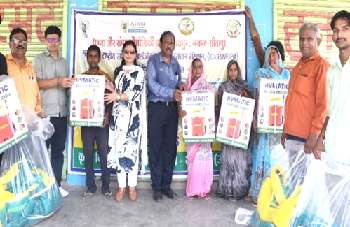
The programme also highlighted the important role of Farmer Producer Organizations (FPOs) in collective marketing, resource management, and dissemination of agricultural technologies among farmers.
It was emphasized that Krishi Vigyan Kendras are continuously promoting need-based agricultural technologies and capacity-building programmes to strengthen rural livelihoods and enhance farmers’ income through agriculture-based entrepreneurship.
A large number of farmers, women self-help groups and rural youth expressed keen interest scientific farming technologies. The Participants were enthusiastic about the implementation of digital platforms can transform pest control from a fragmented and often inefficient process into a smart, responsive and farmer-centric solution that enhances productivity and protects both crops and ecosystems.
(Source: ICAR-National Research Institute for Integrated Pest Management, New Delhi)





फेसबुक पर लाइक करें
यूट्यूब पर सदस्यता लें
X पर फॉलो करना X
इंस्टाग्राम पर लाइक करें