


For small and marginal farmers in tribal communities, farming has long been a story of perseverance amid uncertainty. Across India’s diverse hill and plain regions, limited access to quality seed material, inadequate scientific guidance and continued reliance on traditional, low-yielding agricultural practices have constrained productivity, making it difficult for farmers to realise the full potential of their land. Addressing these challenges, the ICAR–Central Potato Research Institute, through its Tribal Sub-Plan (TSP), has been working to bring scientific potato cultivation within the reach of tribal farmers, equipping them with improved technologies, essential agricultural inputs and practical knowledge to enhance farm productivity.
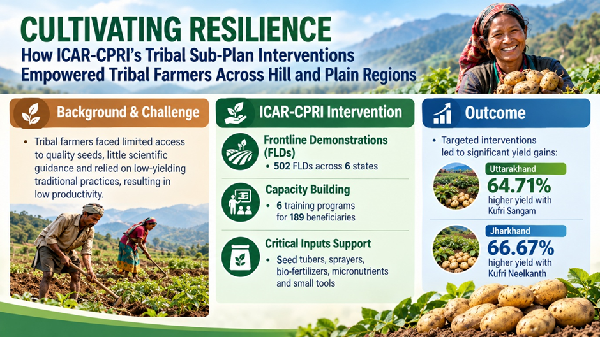
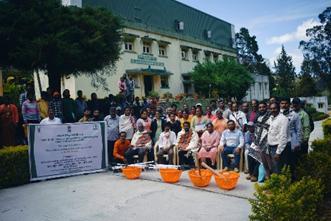
Recognising that agricultural challenges vary across terrains and farming conditions, ICAR-CPRI implemented 502 Frontline Demonstrations (FLDs) across Madhya Pradesh, Jharkhand, Uttarakhand, Tamil Nadu, Gurez in Jammu and Kashmir, and Lahaul-Spiti in Himachal Pradesh. These demonstrations showcased scientific potato cultivation practices, enabling farmers to experience the potential of improved technologies under field conditions. Complementing these efforts, the Institute organised six on-campus and off-campus training programmes, benefiting 189 farmers through capacity building in quality seed production and improved potato cultivation technologies.
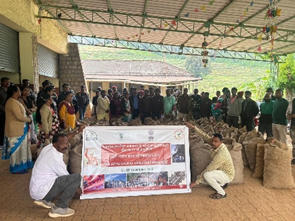
To ensure that farmers could translate knowledge into practice, the initiative also addressed their critical input requirements. Approximately 200 quintals of seed tubers, along with 100 sprayers, bio-fertilisers, micronutrients and small agricultural tools, were distributed to support the adoption of improved farming practices. By combining field demonstrations, hands-on training and essential agricultural inputs, the programme sought to bridge the gap between scientific knowledge and its practical application, enabling tribal farmers to explore more productive approaches to potato cultivation.
The impact of these interventions was reflected in the field results, demonstrating the promise of improved potato varieties over traditional farming methods. In Uttarakhand, cultivation of Kufri Sangam recorded a 64.71% higher yield, while in Jharkhand, Kufri Neelkanth achieved a 66.67% higher yield compared with traditional practices. These gains underscore the potential of science-led agricultural interventions to improve productivity when suitable technologies are supported by training and access to critical inputs.
Through its Tribal Sub-Plan initiatives, ICAR-CPRI is helping create pathways for tribal farmers to move beyond the limitations of conventional cultivation and embrace improved potato production practices. By taking scientific technologies to diverse farming landscapes and strengthening farmers’ capacity to adopt them, the Institute is advancing a more productive and resilient approach to agriculture—one that recognises the potential of tribal farming communities and supports their efforts to build better agricultural livelihoods.
(Source: ICAR-Central Potato Research Institute, Shimla)





Like on Facebook
Subscribe on Youtube
Follow on X X
Like on instagram