


30 September 2026, Dehradun
ICAR-Indian Institute of Soil & Water Conservation, Dehradun, organised an awareness-cum-training and demonstration programme on “Promotion of Agroforestry Systems and Bioengineering for Soil and Water Conservation in Hilly Regions” in Sundaraya, Kolhara and Kofti villages of Khatar, Kalsi, Dehradun, under the Scheduled Caste Sub-Plan (SCSP) programme. The programme aimed to promote sustainable agroforestry practices, strengthen soil and water conservation measures and demonstrate suitable plant-based interventions for erosion-prone and degraded hill areas.
As part of the programme, 800 multipurpose plants, comprising 200 guava, 200 amla, 200 Kachnar and 200 bamboo plants, were planted and demonstrated with the active participation of local farming communities. The initiative directly benefited 30 farm families, with more than 110 farmers and community members participating in the programme.
The SCSP team conducted the programme under the guidance of Dr Shakir Ali, Director, ICAR-IISWC, Dehradun, along with senior officials of the Institute. A technical lecture highlighted the significance of agroforestry in hilly regions and its potential to reduce runoff and soil erosion, improve farm productivity, diversify farm income and contribute to the restoration of degraded landscapes. Farmers were also sensitised to the importance of selecting suitable multipurpose species based on land type, slope, soil conditions and their specific requirements.
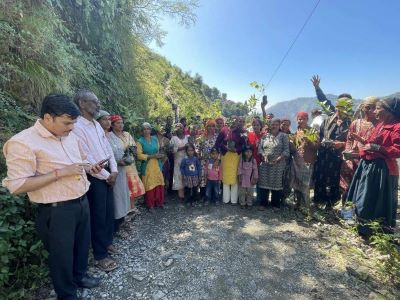
A field-level plantation and demonstration were undertaken to showcase the application of agroforestry and bioengineering approaches for soil and water conservation. Bamboo and Kachnar were planted on sloping, highly erosion-prone and degraded areas to demonstrate their potential to establish vegetation cover, reduce soil loss and help stabilise vulnerable slopes. The activity highlighted the role of perennial vegetation, when integrated with suitable physical and biological measures, in restoring degraded hill landscapes.
At the same time, farmers planted guava and amla along field bunds, demonstrating how fruit-based agroforestry can be integrated into existing agricultural fields. The approach offers opportunities for additional fruit production, farm diversification and supplementary income while contributing to the productive use of field boundaries. Farmers were provided practical guidance on planting methods, spacing, site selection and post-plantation management.
The initiative reflected ICAR-IISWC’s field-oriented approach towards promoting climate-resilient agroforestry, bioengineering-based soil and water conservation, restoration of degraded hill slopes and livelihood diversification among farming communities. The demonstrated models are expected to encourage farmers to adopt suitable perennial vegetation on field bunds, degraded lands and erosion-prone slopes, contributing to the sustainable management of land and water resources in the hilly regions.
(Source: ICAR-Indian Institute of Soil & Water Conservation, Dehradun)





फेसबुक पर लाइक करें
यूट्यूब पर सदस्यता लें
X पर फॉलो करना X
इंस्टाग्राम पर लाइक करें