

5 January 2026, Kasargod
ICAR–Central Plantation Crops Research Institute, Kasaragod, celebrated its 110th Foundation Day today, marking the occasion with the inauguration of the 26th Plantation Crops Symposium (PLACROSYM XXVI). The event was inaugurated by Prof. Siddu P. Algur, Vice Chancellor, Central University of Kerala.
In his inaugural address, Prof. Algur highlighted the major challenges confronting the plantation sector, including climate risks, price volatility, and labour shortages. He emphasized the critical role of research, technological integration, inter-institutional collaboration, and the application of data analytics, predictive modelling, and precision farming particularly through mobile-based platforms to strengthen future agriculture.

The Foundation Day celebrations were complemented by PLACROSYM XXVI, held from 5 to 7 January 2026, under the theme “Future Proofing Plantation Sector for Wellbeing and Welfare.” The symposium brought together over 200 delegates comprising scientists, academicians, policymakers, industry experts, and progressive farmers from across the country.
The Guest of Honour, Dr. P. Rethinam, President, SOPOPROD, underscored the importance of selecting crops suited to local agro-climatic conditions and commended the institute’s dedicated research and extension efforts.
Delivering the introductory remarks and presidential address, Dr. K. Balachandra Hebbar, Director, ICAR-CPCRI, outlined the symposium’s focus on critical areas such as climate change adaptation, resource-use efficiency, pest and disease management, value addition, mechanization, carbon sequestration, and strategies to enhance farmers’ income. He also highlighted major institutional achievements, including the licensing of improved coconut varieties to private nurseries, the development of the low-arecoline arecanut variety Shatamangala, and the establishment of polyclonal cocoa orchards across South India.
The programme was graced by several eminent dignitaries, including Dr. J. Dinakara Adiga, Director, ICAR-DCR, Puttur; Dr. K. Suresh, Director, ICAR-IIOPR, Pedavegi; Dr. K.U.K. Nampoothiri, Former Director, ICAR-CPCRI; Dr. Debabrata Roy, Director, RRII, Kottayam; Dr. Senthilkumar, Director, CCRI; Dr. Victor J. Ilango, Director, UPASI, Valparai; and Dr. A.B. Rema Shree, Director, ICRI (Spices Board), Myladumpara.
As part of the programme, Dr. K.U.K. Nampoothiri delivered a memorial lecture titled “Hunger Elimination” in memory of Dr. K.V. Ahamed Bavappa, elaborating on key indices such as the Global Poverty Index (GPI), Multidimensional Poverty Index (MPI), and Dietary Health Index (DHI).
The event witnessed the launch of several innovative coconut-based products, including Kalpa Kulfi, Kalpa Wafer Cone, Kalpa Velvet (dark chocolate), and Kalpa Qbitz (nata de coco), along with YGP coconut products such as Sappy Drink and Sappy Healthy Sugar. Key publications and digital initiatives were also released, including the PLACROSYM souvenir, an e-book of abstracts, a technical bulletin from the Regional Station, Kayamkulam, and the KVK Kasaragod YouTube channel.
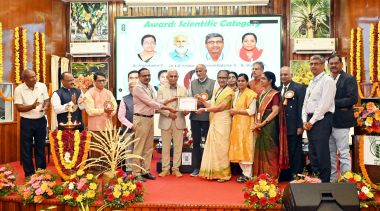
During the inaugural session, Memoranda of Understanding (MoUs) were exchanged with two entrepreneurs Sri Binoy P.C. of Chully Firm for the Kalpa Suvarna coconut variety, and Mrs. Renuka of M/s Bliss Farm Flav for virgin coconut oil and coconut-based delicacies.
Outstanding contributions were recognized through various awards. Progressive farmers were also felicitated for their valuable contributions to the plantation sector.
The three-day event featured scientific deliberations, exhibitions, and recognition ceremonies, with active participation from about 400 attendees, including scientists, farmers, students, entrepreneurs, retired staff, and PLACROSYM delegates.
(Source: ICAR–Central Plantation Crops Research Institute, Kasaragod)





फेसबुक पर लाइक करें
यूट्यूब पर सदस्यता लें
X पर फॉलो करना X
इंस्टाग्राम पर लाइक करें