

Little millet, native to India and one of the most resilient yet underutilised small millets, has long served as a critical food and nutritional resource for farming communities cultivating in marginal and low-input environments. Despite its remarkable ability to thrive under drought, salinity and water-logging conditions, and its naturally high iron and dietary fibre content, the crop has historically remained neglected in mainstream crop improvement programmes. Its growing prominence in recent years as a nutritious gluten-free grain and a climate-smart food ingredient has created an urgent need for advanced genomic resources to accelerate its improvement and global utilisation.
Responding to this need, the Indian Council of Agricultural Research (ICAR) has achieved a landmark scientific breakthrough by decoding and releasing the first chromosome-scale reference genome of little millet (Panicum sumatrense). This pioneering work, conducted by the Global Centre of Excellence on Millets (Shree Anna) at the ICAR–Indian Institute of Millets Research, Hyderabad, in collaboration with the University of Saskatchewan, Canada, the National Research Council in Saskatchewan, Canada, and the University of Agricultural Sciences, GKVK-Bangalore, has been published in Nature Communications (https://doi.org/10.1038/s41467-025-66716-6). The accomplishment marks a major milestone for India’s leadership in millet genomics and strengthens global efforts to advance research on climate-resilient crops.
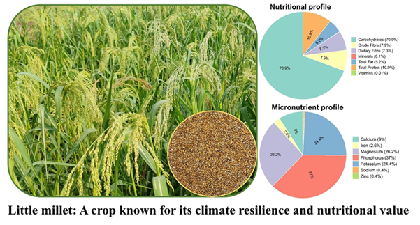
Using a hybrid sequencing strategy that combined long-read and short-read technologies, the researchers developed a highly complete genome assembly for the genotype JK-8. The final assembly spans 18 chromosomes and includes 59,000 annotated protein-coding genes responsible for key crop traits, including resilience to challenging climates, nutritional qualities and grain characteristics. Notably, seven chromosomes were assembled from telomere to telomere, reflecting exceptional continuity and accuracy. The team also analysed 300 little millet varieties sourced from across India, identifying nearly 250,000 SNP genetic markers. These markers offer valuable insights into how traits such as yield and nutrient content vary among varieties. This integrated genomic and phenotypic dataset represents one of the most comprehensive resources ever developed for any small millet species.
The discoveries provide important molecular targets for breeders and pave the way for the development of improved varieties using molecular breeding, marker-assisted selection, genomic selection and targeted gene-editing approaches. This breakthrough holds significant implications for global food and nutritional security. Little millet is increasingly recognised as a climate-resilient crop capable of thriving in degraded soils, high-stress environments and regions vulnerable to climate variability. Its exceptional iron content positions it as a promising candidate for combating micronutrient deficiency in both rural and urban populations. With the availability of the reference genome and large-scale molecular dataset, the crop can now be systematically improved for yield stability, nutritional fortification, stress adaptation and suitability for modern food product development.
It is noteworthy that this breakthrough was achieved at the Global Centre of Excellence on Millets (Shree Anna), which was formally dedicated to the nation by the Prime Minister in March 2023. Established with a clear mandate to advance millet research, accelerate varietal improvement, promote millet cultivation and foster global partnerships, the Centre embodies India’s commitment to expanding scientific innovation in under-researched crops. The decoding of the little millet genome reflects this vision and reinforces India’s leadership in the post-International Year of Millets era. With this accomplishment, ICAR is now well-positioned to drive next-generation breeding, deepen international collaboration, and rapidly develop nutrient-rich, climate-smart little millet varieties for farmers and consumers worldwide.
(Source: ICAR - Indian Institute of Millets Research, Rajendranagar, Hyderabad)




फेसबुक पर लाइक करें
यूट्यूब पर सदस्यता लें
X पर फॉलो करना X
इंस्टाग्राम पर लाइक करें