


In the serene village of Tamaloo in Car Nicobar lives Shri Leslie, a progressive farmer whose journey toward sustainable agriculture stands as a testament to innovation, resilience, and self-reliance. Through the successful establishment of a comprehensive Integrated Farming System (IFS) over an area of 2000 m² (excluding coconut plantation), he has emerged as a role model inspiring environmentally sound and diversified farming practices in the region. With continuous technical guidance and institutional support from ICAR–KVK (Central Island Agricultural Research Institute), Nicobar, in consultation with ICAR- Agricultural Technology Application Research Institute, Kolkata, he has transformed his traditional farming practice into a resilient, self-sustaining and income-generating enterprise.
Impact of KVK Interventions
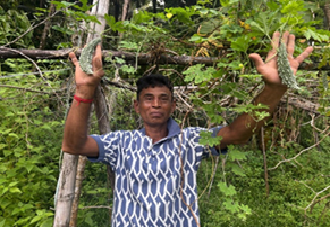
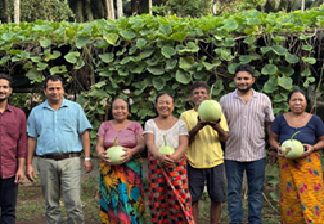
Through scientific planning and diversification, Shri Leslie integrated vegetable and fruit cultivation, poultry farming, piggery, goat rearing, beekeeping and copra production into a single, well-coordinated system. He cultivates high-value vegetables such as okra, brinjal, chilli, leafy vegetables and cucurbits, alongside fruit crops like banana, papaya and pineapple perfectly suited to the local agro-climatic conditions. This diversification ensures year-round income, household nutritional security and reduced risk from crop failure.
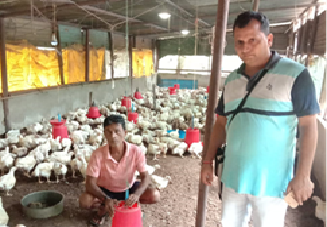
Livestock plays a pivotal role in his farming model. Poultry provides regular income through eggs and meat, while pigs and goats serve as high-return assets. Importantly, animal waste is efficiently recycled as organic manure, creating a closed-loop nutrient system that improves soil health and significantly reduces input costs.
His coconut plantation adds further value through copra making, an enterprise closely aligned with the local economy. With KVK support, Shri Leslie now plans to adopt improved copra drying technologies to enhance quality and market returns.
Targeted interventions by ICAR–KVK Nicobar such as supply of improved crop varieties, bio-inputs, mineral mixtures for poultry, introduction of beekeeping, farm machinery support and low-cost water harvesting structures played a catalytic role in scaling up productivity and profitability.
Economic Transformation
Before KVK intervention, livelihood options were largely restricted to copra making, supplemented by marginal and irregular income from agriculture, offering limited scope for economic growth. Following the intervention, adoption of an integrated farming system resulted in a substantial enhancement in farm profitability, generating a net annual return of ₹2.43 lakh with an overall B:C ratio of 2.55, clearly establishing the economic viability and sustainability of IFS. Poultry, piggery, and vegetable cultivation emerged as the principal income drivers, contributing to diversified income streams and improved livelihood security.
Environmental and Social Benefits
The farm now operates on eco-friendly principles enhanced soil fertility, reduced chemical use, efficient waste recycling and improved biodiversity. The diversified system has strengthened climate resilience and created local employment opportunities.
Scaling and Inspiration
Shri Leslie’s farm has become a live demonstration unit, inspiring neighbouring farmers and rural youth to adopt Integrated Farming Systems. Through farmer-to-farmer learning and KVK-led trainings, his model holds strong potential for horizontal and vertical expansion across Nicobar.
Conclusion
Shri Leslie’s journey vividly demonstrates how timely scientific support, thoughtful diversification, and judicious use of limited natural resources can transform small and fragmented landholdings into resilient, sustainable, and economically viable farming enterprises. By adopting location-specific technologies, improved production practices, and integrated farming approaches promoted through ICAR–KVKs, he was able to reduce risk, enhance productivity, and stabilize income under the fragile and climate-sensitive conditions of the Nicobar Islands.
His experience underscores the critical importance of continuous handholding, skill-oriented capacity building, and adaptive extension services in island ecosystems, where land, inputs, and market access remain constrained. Beyond individual economic gains, Shri Leslie’s success highlights a scalable pathway for strengthening food security, ecological balance, and livelihood resilience in remote island regions. It reaffirms the catalytic role of ICAR–KVKs in translating scientific knowledge into field-level impact, fostering farmer confidence, and nurturing sustainable agriculture models that are both locally relevant and environmentally responsible.
(Source: ICAR- Agricultural Technology Application Research Institute, Kolkata)





Like on Facebook
Subscribe on Youtube
Follow on X X
Like on instagram