


India’s equine breeding sector is witnessing a new era of scientific advancement, driven by the successful translation of cutting-edge reproductive technologies from research laboratories to breeding farms. At the forefront of this transformation is Equine Breeding India (EBI), Bengaluru, led by Shri Navaneet, whose vision, entrepreneurial spirit and commitment to scientific breeding have established one of the country’s advanced private equine reproductive facilities.
The story of EBI is a compelling example of how research-led entrepreneurship can transform scientific innovation into a practical, commercially viable and field-oriented solution. Its journey gained momentum with the adoption of two landmark technologies developed by ICAR–National Research Centre on Equines, Bikaner, in 2021: “Semen Collection and Cryopreservation in Indigenous Horses” and the “Customized Artificial Vagina (AV) for Stallion Semen Collection.” Developed by Dr. T. R. Talluri and his team under the leadership of Dr. T. K. Bhattacharya, Director, ICAR–NRCE, these technologies provided the scientific foundation for bringing advanced semen cryopreservation and assisted reproductive services closer to India’s equine breeding industry.
Turning Scientific Innovation into Breeding Infrastructure
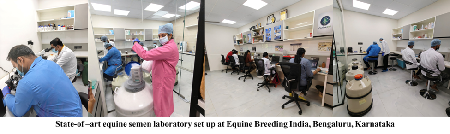
Building on the ICAR–NRCE technologies, Equine Breeding India established a state-of-the-art equine semen processing and cryopreservation laboratory, equipped for standardized semen evaluation, processing, quality assurance and long-term cryogenic storage.
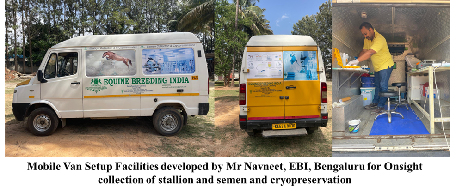
Recognizing that access to technology is as important as the technology itself, EBI went a step further by developing a fully equipped mobile reproductive unit. The unit enables on-site stallion semen collection, cryopreservation, transportation of frozen semen and artificial insemination services at breeding farms across the country.
This integrated approach has helped overcome one of the key logistical challenges in equine breeding—the need to transport valuable breeding stallions. Instead, reproductive material can be collected, preserved and transported, allowing breeders to access elite genetics without moving the animal itself.
From Frozen Semen to Healthy Foals
The real measure of a technology lies in its ability to deliver results in the field. Leveraging its advanced infrastructure and the ICAR–NRCE technologies, EBI has successfully collected semen from elite stallions across India and cryopreserved semen from genetically superior bloodlines.
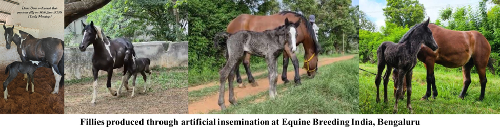
These cryopreserved and chilled semen doses have subsequently been utilized for artificial insemination, leading to the successful production of healthy foals. More recently, the EBI team has produced live foals through artificial insemination using both cryopreserved and chilled semen—demonstrating the practical potential of advanced reproductive technologies in supporting scientific horse breeding.
The achievement represents an important transition: a research innovation developed within the ICAR system has moved from technology development to real-world application, breeding success and enterprise creation.
Preserving Elite Genetics, Multiplying Performance
Shri Navaneet’s approach has been guided by a clear objective—to facilitate the multiplication of elite sport and jumping horse bloodlines through scientific breeding and cryopreservation.
By preserving and disseminating superior germplasm, EBI is helping expand access to high-value equine genetics while contributing to the long-term genetic improvement of India’s equine population. The approach also creates an avenue for germplasm conservation, ensuring that superior genetic material can be preserved and made available beyond geographical and logistical limitations.
In this way, reproductive technology becomes more than a breeding tool. It becomes a means of preserving genetic potential, accelerating genetic improvement and creating new economic opportunities for breeders.
Making Scientific Breeding More Efficient and Economically Viable
The adoption of semen cryopreservation technology has also demonstrated the economic potential of scientific equine breeding. Under natural mating, a single covering, costing approximately ₹1.5 lakh, is utilized for one mare. In contrast, a single ejaculate can produce around 5–10 frozen semen doses, with each dose costing approximately ₹10,000–15,000.
This multiplication of breeding material allows elite genetics to be utilized across a larger number of mares while offering logistical and biosecurity advantages.
The economic value generated through superior breeding further highlights the potential of the technology. Foals produced from superior bloodlines typically command ₹5–10 lakh, while trained sport and jumping horses may be valued at ₹25–30 lakh or more. Thus, scientific breeding is not only improving reproductive efficiency but also opening pathways for value creation across the equine industry.
A New Model of Research-Led Entrepreneurship
The journey of Equine Breeding India reflects the power of collaboration between public-sector agricultural research and private-sector entrepreneurship. ICAR–NRCE provided the scientific technology; Shri Navaneet transformed that knowledge into infrastructure, services and field-level applications.
The result is a model in which research does not remain confined to laboratories or scientific publications. Instead, it reaches breeders, farms and animals, generating measurable outcomes while creating a viable enterprise.
Today, Equine Breeding India represents an emerging model of technology commercialization in animal reproduction, demonstrating how institutional research can catalyse private innovation and accelerate the adoption of advanced technologies in the field.
From Research to Impact
The journey of Shri Navaneet and Equine Breeding India is ultimately a story about what becomes possible when scientific knowledge meets vision, enterprise and persistence.
What began with the adoption of ICAR–NRCE technologies has evolved into an integrated breeding ecosystem encompassing semen collection, cryopreservation, artificial insemination, mobile reproductive services and elite germplasm management. More importantly, it has demonstrated that sophisticated reproductive technologies can be adapted to Indian conditions and translated into tangible breeding outcomes.
The emergence of healthy foals through artificial insemination using chilled and cryopreserved semen is a powerful testament to this journey. It illustrates how technology transfer can move beyond commercialization to create genuine field-level impact.
Equine Breeding India’s journey, led by Shri Navaneet, therefore stands as a compelling example of research-led entrepreneurship in action where cutting-edge ICAR science, private initiative and a commitment to excellence are coming together to reshape the future of scientific equine breeding in India.
From laboratory innovation to living success, the journey of Equine Breeding India demonstrates how the right technology, in the hands of a determined entrepreneur, can turn scientific potential into lasting impact.





Like on Facebook
Subscribe on Youtube
Follow on X X
Like on instagram