


28 July 2026, Sundargarh
In a significant step towards strengthening climate-resilient agriculture, the Research–Extension Interface Meeting was held at KVK (OUAT) Sundargarh-I, under the jurisdiction of ICAR- Agricultural Technology Application Research Institute, Kolkata, to formulate a coordinated district-level strategy for tackling the anticipated impacts of El Niño during the Kharif 2026 season. The meeting brought together senior officials from key line departments, including the Chief District Agriculture Officer (CDAO), Deputy Director of Horticulture, Project Director (Soil Conservation), Chief District Veterinary Officer, District Fisheries Officer, District Development Manager, Superintending Engineer (Minor Irrigation), Odisha Agro Industries Corporation, Regional Research Technology Transfer Sub-Station, Cooperative Department, along with Senior Scientist & Head, KVK Sundargarh-I and KVK Sundargarh-II, scientists, NGO representatives, Farmer Producer Organizations (FPOs), and progressive farmers and farmwomen.
The deliberations focused on the prevailing rainfall scenario, which recorded a 67% rainfall deficit during June followed by 40% excess rainfall in July, underscoring the need for timely contingency planning and adaptive agricultural interventions.
Presenting the district crop scenario, the Chief District Agriculture Officer informed that nearly 50% of the cropped area had been covered through broadcasting, while the remaining area was being prepared for transplanting. In view of the delayed monsoon and climatic uncertainty, the meeting recommended crop diversification through promotion of maize under the Mukhyamantri Makka Mission, millets under the Odisha Millet Mission, pigeon pea, black gram, sesame, and groundnut to reduce production risks and enhance farmers' resilience.
The officials emphasized implementing the district contingency plan through regular weather-based agro-advisories via SMS and WhatsApp, strengthened Kisan Sarathi advisory services, continuous monitoring of crop health, pests, diseases and moisture stress, and promotion of climate-resilient technologies, moisture conservation, alternate cropping systems, drought mitigation, and efficient water management.
Reflecting on the interface, Director, ICAR-ATARI, Kolkata said: “ICAR-ATARI Kolkata is committed to fostering research–extension convergence to enhance farmers' resilience against climate variability. Strengthening district-level preparedness, promoting science-based climate-smart agriculture, timely advisory services and ensuring effective inter-departmental coordination will remain our key priorities for sustainable agricultural development.”
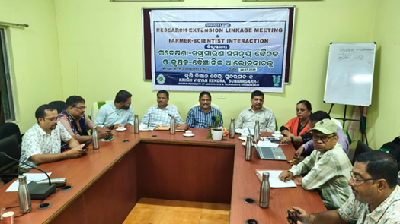
A comprehensive review of the availability of quality seeds, fertilizers, bio-fertilizers, bio-pesticides, microbial consortia, and other agricultural inputs was undertaken to ensure timely supply at the block and Gram Panchayat levels. The meeting also highlighted the importance of increasing farmers' awareness of Pradhan Mantri Fasal Bima Yojana (PMFBY) and other Government schemes, promoting green manuring, and optimizing fertilizer use for sustainable crop production.
The Project Director, Soil Conservation Department, presented innovative agroforestry initiatives aimed at enhancing food and nutritional security, while the Deputy Director of Horticulture emphasized expansion of fruit plantations under drip irrigation through PMKSY and promotion of mushroom cultivation as an additional livelihood opportunity.
Officials from the Animal Resources Development Department advocated integrated farming approaches by promoting fodder cultivation, azolla production, dairy development, poultry, and goat farming to strengthen rural livelihoods.
The District Development Manager, NABARD, highlighted the JIVA Project promoting natural farming and proposed an exposure visit to the biodigester unit at Bijaghat village, Lahunipada Block, where advanced Jeevamruta preparation techniques are being demonstrated for wider adoption.
One of the major outcomes of the meeting was the decision to constitute a multidisciplinary district monitoring team comprising officials from line departments and KVK scientists. The team will regularly monitor crop conditions, input availability, pest outbreaks, and emerging field situations, while providing timely reports and recommendations to the District Collector for prompt intervention.
The meeting concluded with a strong commitment from all participating departments to work in close convergence with KVK Sundargarh-I for effective implementation of climate-resilient interventions. The stakeholders resolved to strengthen inter-departmental coordination, ensure timely field-level action, and safeguard agricultural production and farmers' livelihoods against the anticipated challenges of El Niño during Kharif 2026.
(Source: ICAR- Agricultural Technology Application Research Institute, Kolkata)





Like on Facebook
Subscribe on Youtube
Follow on X X
Like on instagram