


In the mist-laden hills of Dzongu in North Sikkim home to the indigenous Lepcha community farming has long been a labor of resilience. Practiced on narrow, steep terraces under organic systems, agriculture here has traditionally depended on human labor and draught animals. But rising labor shortages, escalating wages, and the physical demands of hill farming were steadily eroding both productivity and profitability.
A quiet transformation began in early 2022.
Recognizing these challenges, the ICAR NEH Sikkim Centre introduced a community-driven approach to farm mechanization under the Tribal Sub Plan (TSP). Instead of large, impractical machines, the focus was on portable, lightweight, and need-based tools tailored for the hills. At the heart of this shift was a compact 3-HP tiller-cum-weeder light enough to be carried across terraces, yet powerful enough to replace traditional bull-driven ploughing.
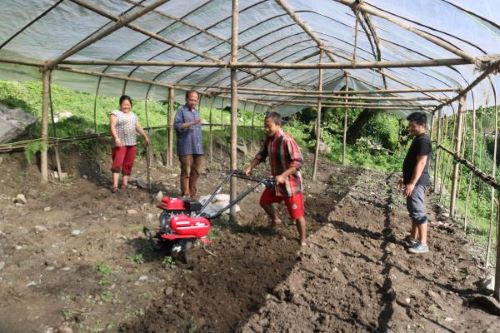
What followed was more than just a technological upgrade it was a social movement.
Across 12 Lepcha villages, 86 farmer clusters were formed, bringing together scattered households into collaborative units. Through community demonstrations and shared access via custom hiring centers, 619 tribal farmers began adopting these machines. Women and elderly farmers, often the backbone of hill agriculture, found the equipment especially empowering due to its ease of use.
The results were immediate and striking.
Manual labor demands dropped dramatically by up to nearly 70% in some cropping systems. Operational costs fell by almost half, while efficiency nearly doubled. The burden of maintaining draught animals disappeared, and farm operations that once took days could now be completed in hours. Even livestock farming saw a boost, with chaff cutters reducing daily feed preparation time by over 60%.
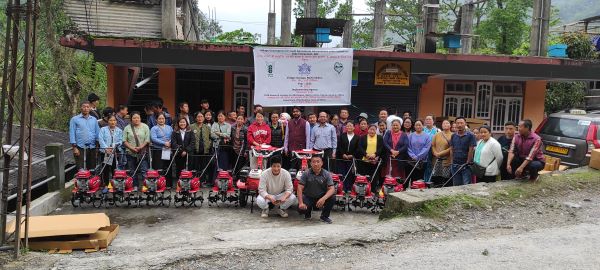
But the real story of transformation lay beyond the fields.
As machines became central to farming, a new challenge emerged maintenance and repair. Addressing this gap, a targeted skill development program was launched in 2024, training selected Lepcha youth at a specialized institute in Assam. This hands-on training in machinery repair, maintenance, and operation planted the seeds of entrepreneurship.
Three young trainees from Dzongu took that seed and made it grow.
Pooling their determination and resources, they established local repair and spare-parts services in their villages. For the first time, farmers in these remote hills had access to reliable, nearby technical support. Their initiative quickly gained momentum, evolving into a thriving rural enterprise with monthly earnings ranging between ₹18,000 and ₹30,000.
Their work did more than generate income it built trust, reduced downtime for farmers, and strengthened the mechanization movement. Soon, their services extended beyond their villages, reaching even the remote stretches of upper Dzongu through door-to-door support.
Today, these young entrepreneurs stand as catalysts of change.
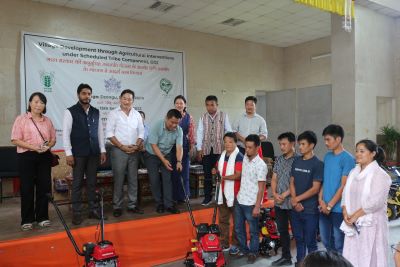
What began as an effort to ease farm labor has blossomed into a model of community-led development where technology meets tradition, and skill meets opportunity. Mechanization not only enhanced productivity but also unlocked new livelihoods, reduced drudgery, and strengthened the local economy.
In the Lepcha heartland of Sikkim, the sound of machines now echoes alongside the rhythm of tradition signaling not disruption, but progress rooted in empowerment.
(Source: ICAR Research Complex for NEH Sikkim center - Tadong, Department of Agriculture/ Horticulture, Govt. of Sikkim)





Like on Facebook
Subscribe on Youtube
Follow on X X
Like on instagram